
OCT 17 | 10:00 PM

Bring your auction to collectors worldwide!
Get listed nowBy subscribing, you are agreeing to the privacy policy. Unsubscribe anytime.
Barnebys HQ
Brahegatan 10
BOX 5038
114 37 Stockholm
All auctions / Miscellaneous / Constantin Colibaba

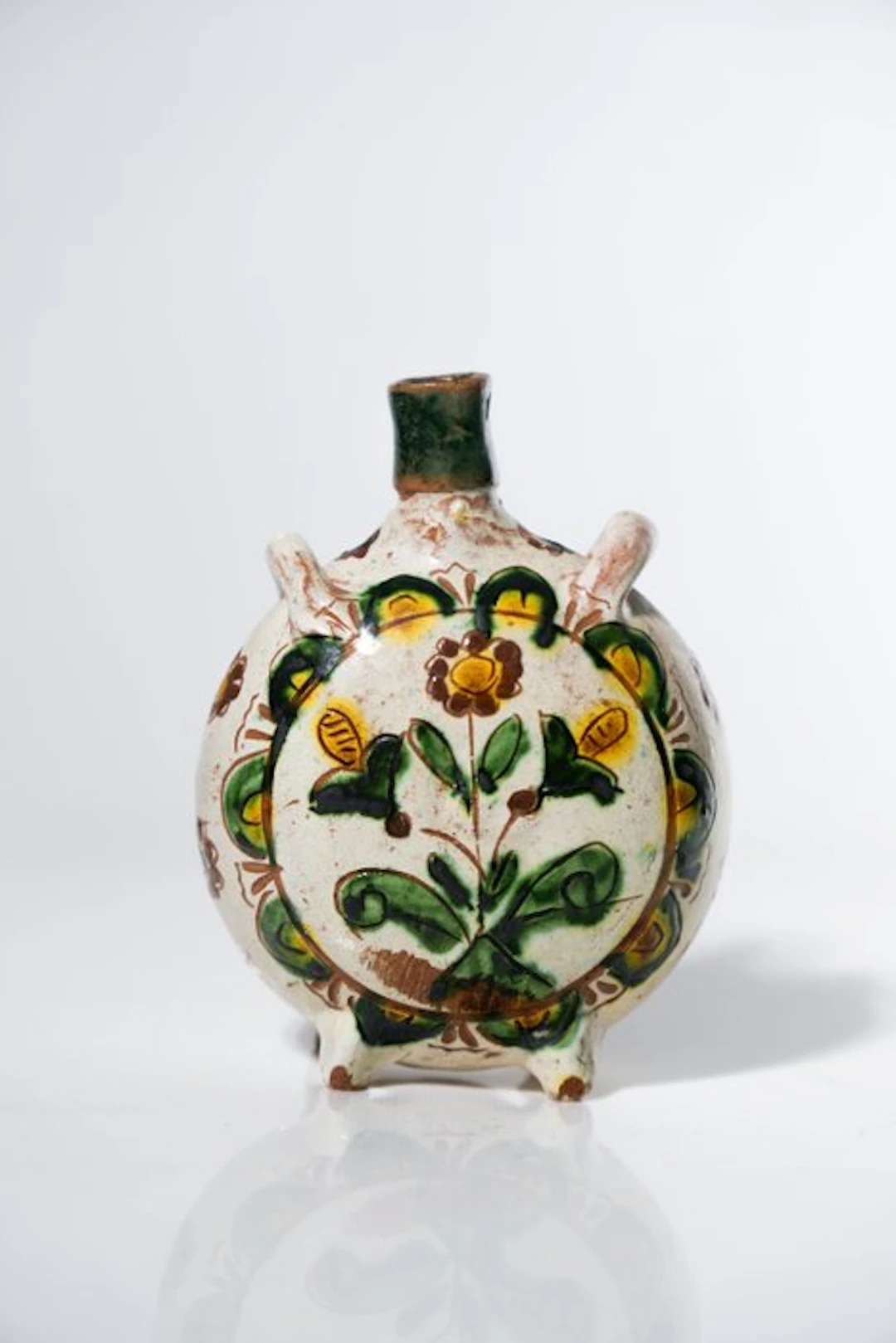
Constantin Colibaba, Antique "Plosca" Pilgrim Flask, Kuty Ceramics, Rădăuți, Romania Hand-thrown and hand-painted sgraffito folk pottery, early-mid 20th century A remarkable example of "Ceramica de Kuty", one of the most distinctive and historically significant folk pottery traditions of Bucovina, Romania, attributed to the celebrated master potter Constantin Colibaba (1900–1975) of Rădăuți, founder of the legendary Colibaba ceramic dynasty. Formed as a traditional "plosca" (pilgrim flask/canteen), the vessel's rounded, lens-shaped body rests on four small stylised feet, with a pair of pierced lug handles flanking a short cylindrical neck finished in deep emerald green, a silhouette rooted directly in centuries-old shepherd and pilgrim flasks once carried across the Carpathian villages of Bucovina. Each face of the flask is decorated in the master's characteristic sgraffito technique: the design is first incised through a layer of white slip to expose the red clay body beneath, then filled with the traditional Kuty palette of white, green, yellow and brown: colours said to symbolise the four seasons in this regional tradition. One side depicts a proud, boldly stylised rooster within a circular medallion bordered by radiating motifs, a favourite subject of Colibaba's repertoire and a symbol of the rural Bucovinian household; the reverse bears a large stylised flower flanked by butterflies, framed by the same circular border, rendered with the free, confident line that defines the master's hand. Rarity & Historical Significance Kuty ceramics trace their roots to the ancient pottery tradition of Kuty (Кути), a town on the historic border between Bucovina and Galicia, whose distinctive green-and-yellow sgraffito palette is believed to descend, through Byzantine craftsmen, from Middle Eastern pottery traditions reaching back to the first millennium. When this craft was displaced from its original territory, it was Constantin Colibaba who single-handedly revived and preserved it in Rădăuți, fusing the Kuty technique with local Bucovinian motifs to create a wholly original artistic language — one now recognised as a protected cultural heritage tradition, with the Colibaba family workshop itself listed among Romania's historic monuments. Kuty pieces are increasingly scarce on the market and are actively sought after by collectors of Eastern European folk art, many examples now residing in ethnographic museums. Details Technique: Hand-thrown terracotta, sgraffito decoration through white slip, hand-painted glazes Attribution: Constantin Colibaba (1900–1975), Rădăuți workshop, Kuty tradition Form: Traditional "plosca" pilgrim flask with pierced lug handles Motifs: Stylised rooster (obverse) / flower and butterflies (reverse) Origin: Bucovina, Romania Period: Early–mid 20th century Condition: good Dimensions: height: 11 cm, width: 5 cm, lenght: 8,5 cm Signature: traces of signature, although no clear signature is visible A rare survivor of a vanishing folk tradition, a piece as much a cultural artefact as a decorative object, for collectors of authentic Eastern European ceramic heritage.
Estimate:£0.84
To the auctionView all items fromCatawikiorMiscellaneous
Estimate:
£0.84

Rare Antique Miniature Steiff Mohair Bear Circa 1910 with...
09/14/2023
£110.46
Est: £236.7
OCT 17 | 10:00 PM


Bring your auction to collectors worldwide!
Get listed now£144.2