


OCT 8 | 3:00 PM

Bring your auction to collectors worldwide!
Get listed nowBy subscribing, you are agreeing to the privacy policy. Unsubscribe anytime.
Barnebys HQ
Brahegatan 10
BOX 5038
114 37 Stockholm
All auctions / Books, Maps & Manuscripts / PLATO. The complete works that have survived, translated fro - Lot 50

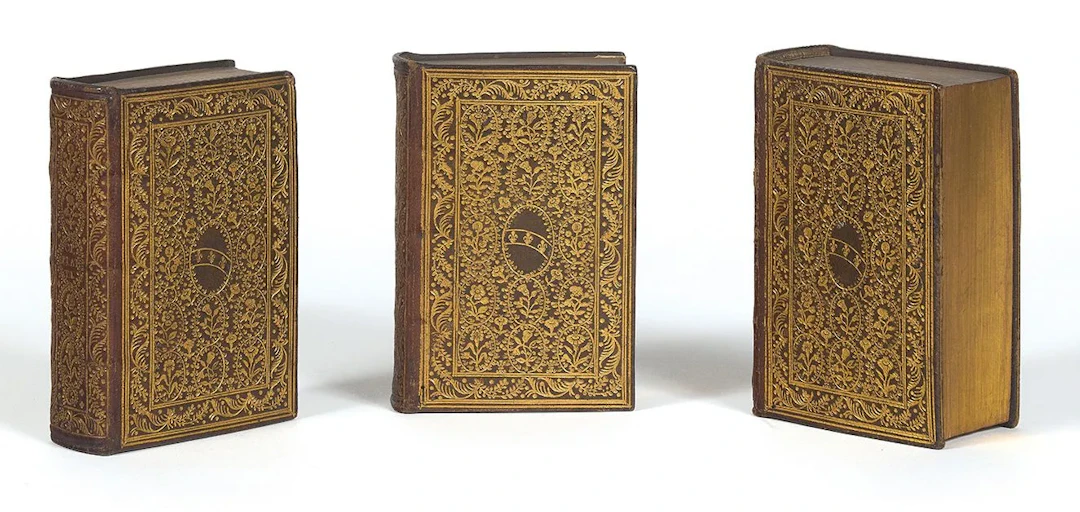
PLATO. The complete works that have survived, translated from the Latin by Marsilius Ficinus, now collated much more carefully than before with the Greek text and emended in numerous places. In this edition, Ficini’s introductions have been supplemented with permanent marginal notes briefly indicating the summary and purpose of each treatise. S.l. (Geneva), published by Jacob Stoer, 1592. Three volumes in-16, contemporary red morocco bindings; on the covers, a border of palm leaves and foliage framing a large central panel decorated witha repeating pattern of medallions containing seven different species of flowers, with a larger oval medallion in the center bearing the owner’s coat of arms on the front cover and his motto, *Expectata non eludet*, surrounding a three-flowered lily stalk on the back cover; smooth spines decorated in the same manner, gilt edges, cases. A beautiful and rare edition of Plato’s works in their most sought-after version, translated and annotated by Marsilio Ficino. Published as early as 1484, this work by the great humanist synthesized Platonism and Christianity, thereby paving the way for Neoplatonic philosophy, which would shape the entire intellectual life of the Renaissance. A medallion portrait of Plato, wood-engraved on the title pages of the three volumes. A superb copy by Pietro Duodo (1554–1611), bound in the characteristic bindings of his library. As ambassador of the Republic of Venice to Henry IV from 1594 to 1597, Duodo took advantage of his stay in Paris to assemble a collection of works, all in small format, which he had bound—following the example of his predecessor Grimaldi—with uniformly decorated bindings in three colors: red for theology, history, law, and philosophy, lemon for medicine and botany, and olive for literature. This collection of approximately 150 volumes (133 cataloged by Esmerian in 1972), typical in its choice of texts—primarily Greek and Latin—of a humanist’s tastes and interests, constituted a traveling library, one of the most remarkable to have survived, both for its content and for the beauty and elegance of its bindings. Suddenly recalled to Venice in 1597, Duodo likely never made use of his books, which remained in Paris for two hundred years before gradually reappearing on the English market after the Revolution.¹ They were initially attributed to Marguerite de Valois, Queen Margot, sister of Henry III and first wife of Henry IV, before Ludovic Bouland’s research2 restored them to their rightful owner. The Parisian workshop responsible for these bindings has not been identified with certainty. While the somewhat generic name of Clovis Eve has long been circulated, today the workshop known as “de la seconde palmette”—the leading producer of fanfare bindings at the turn of the 16th and 17th centuries³—is cited as the source, following the discovery of a small vase motif on two of the bindings in the library. Given the importance of its text, this copy is undoubtedly one of the most remarkable in the Duodo Library. Carefully bound and free of any restoration, it is preserved in the finest condition. In a detail that has gone unnoticed until now, its decoration features a variant not yet cataloged, with seven different small flowers of the same size repeated on the covers instead of the usual six.⁴ From the libraries of George Gosling (auction of July 17, 1883, in London, sold for 127 pounds), Cortland Bishop (II, 1938, no. 1777), and Daniel Sicklès, with their bookplates. This copy appeared in the November 1890 issue of the *Bulletin Morgand* (no. 19100, priced at 5,000 gold francs) as well as in the *Rahir Livres* catalog of books in luxurious bindings, Paris, 1910 (no. 94). It appears in the list of books attributed by Quentin-Bauchart to Marguerite de Valois (no. 12). Minimal signs of wear on one joint of Volume III. 1- They appear in large numbers in 19th-century English collections: “Among the great English bibliophiles of the time, Gosling owned no fewer than 36 Duodo volumes, Thorold 12, Beckford 10, and Rev. Cracherode 9” (Esmerian, I, 1972). 2- L. Bouland. Books Bearing the Coat of Arms of Pierre Duodo, a Venetian, and Not Marguerite de Valois, in *Bulletin du Bibliophile*, Paris, 1920. 3- See Hobson and Culot. *Bookbinding in Italy and France in the 16th Century*, 1990, no. 66. 4- “There are a few variations on this type of decoration: five of the six flowers with an oval and one smaller flower (David, 1533, 4th Rahir auction, 1946, no. 1027); all six flowers plus a seventh for volumes whose slightly larger format requires rows of four ovals (Ronsard, 1587, Quentin-Bauchart, no. 49). Two other variations feature different flowers (Breviarum, 1598, Mme. Louis Solvay’s Library, 1959, no. 90, and Pindare, 1586, Wilmerding auction, 1951, no. 730)” (Hobson and Culot).
Estimate:£17,044.7
To the auctionView all items fromGiquelloorBooks, Maps & Manuscripts
Estimate:
£17,044.7

OCT 8 | 3:00 PM


OCT 8 | 3:00 PM

Bring your auction to collectors worldwide!
Get listed now£17,044.7
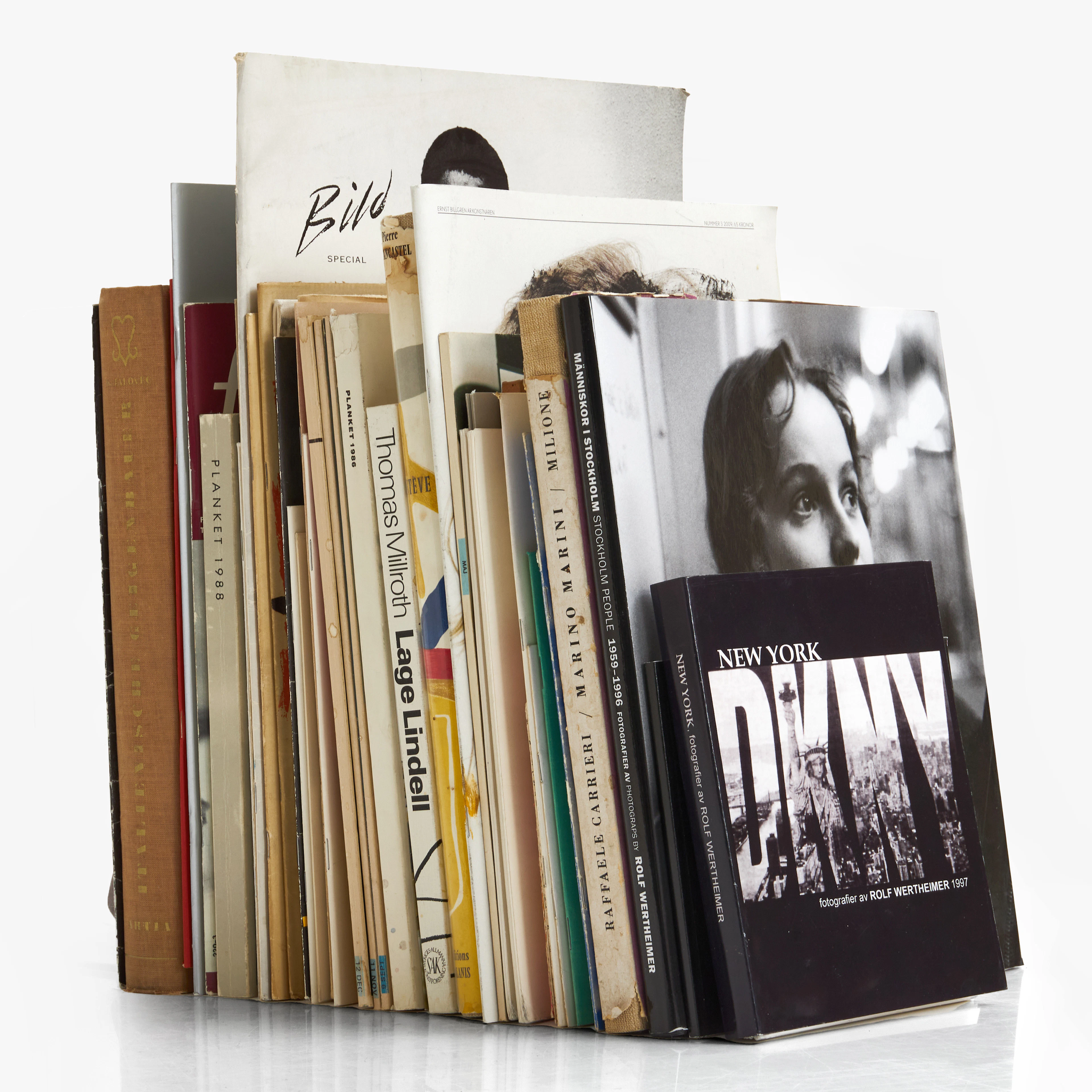
KONSTLITTERATUR, häften mm, ca 40 dlr, Matisse, Michaux, Vieira Da
12/03/2025
£32.96
Est: £63.65

![[HEURES de ROUILLE]. Hours in French and Latin for use in Ro - Lot 37](https://bbys.imgix.net/337/4b192de427c4888d5b04199e72052f323dbb163313ce351dde6db5184d78b537.webp?auto=format&w=3840&q=75)