
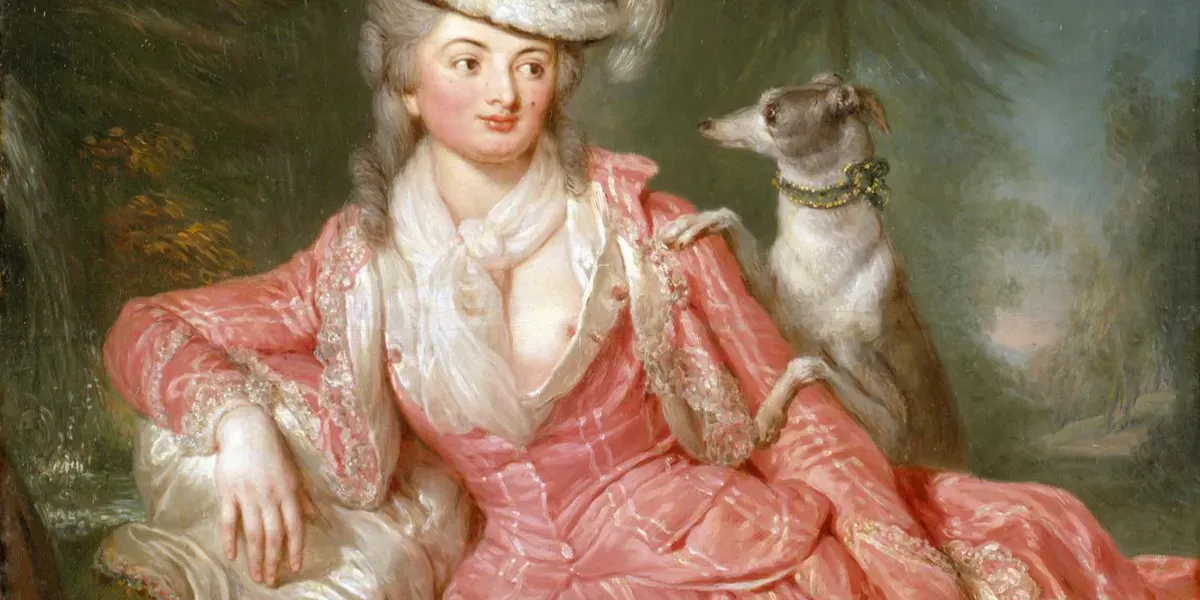
The rise of pink as a fashionable colour began in the 18th century, as the whimsical and light-hearted Rococo style favoured delicate tones. Madame de Pompadour held a particular fondness for the colour, to the extent that the shade of pink devised at the Sèvres porcelain manufactory in 1757 was christened after the royal mistress. During that era, pink adorned not only women but also men, yet since the 20th century, it has increasingly become associated with girls. Whether someone likes pink or not, it undeniably exudes a sense of cheerfulness, regularly commanding attention.
Here are five portraits of five women dressed in pink from the past two centuries.
Berthe Morisot, The Pink Dress, ca. 1870
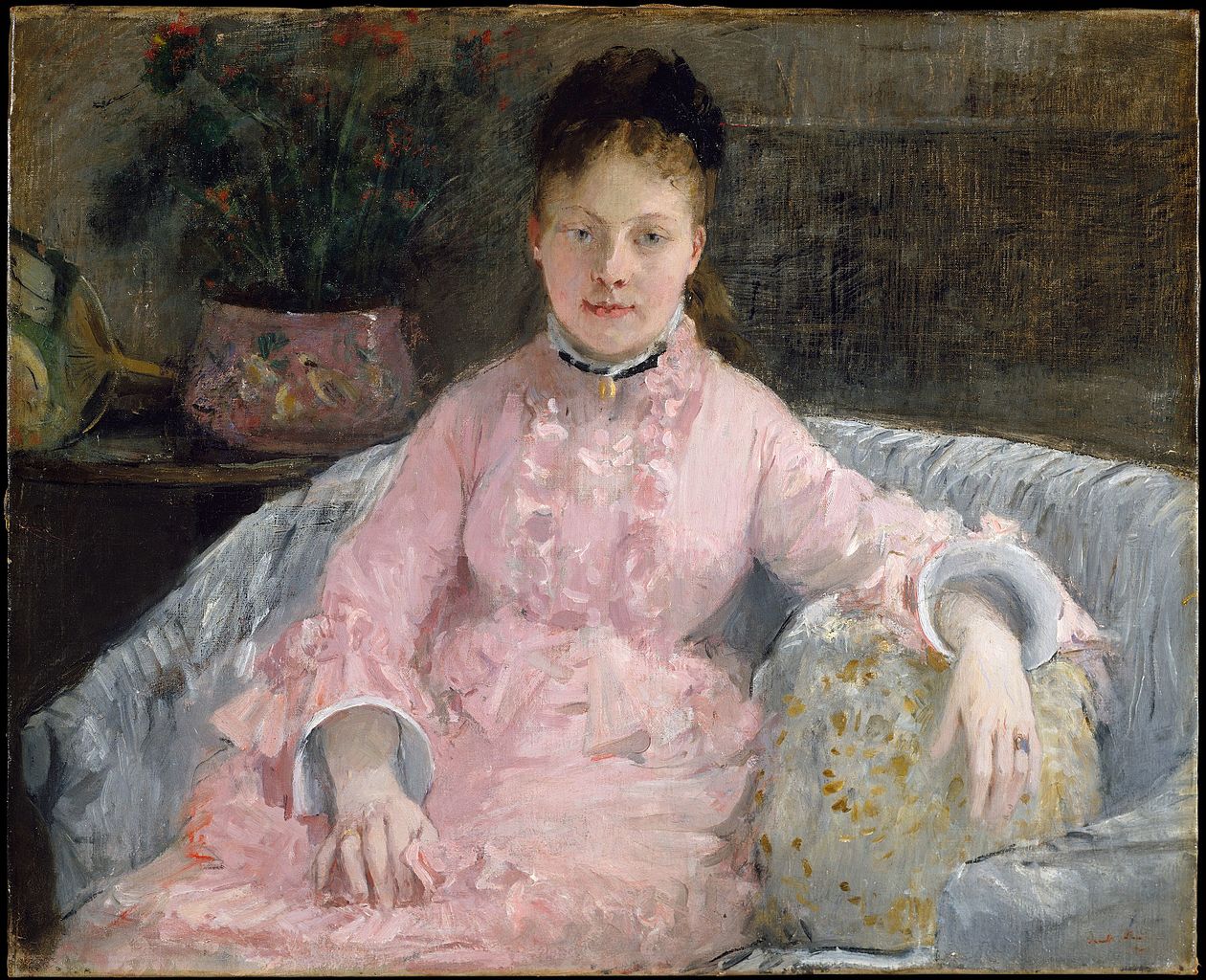
What better painting to kick off an article about paintings featuring pink dresses than one whose title includes just that? Named The Pink Dress, this particular artwork can be found on display at the Metropolitan Museum of Art in New York.
The Pink Dress was painted around 1870 by Berthe Morisot, who had already established herself as a prominent painter in the years prior and had been showcasing her work at the Paris Salon since 1864. Always by her side was her elder sister Edma, who not only painted herself but also frequently posed as a model for Berthe. While the two sisters had previously spent time together copying the works of the Old Masters at the Louvre and receiving private tutelage from various artists, including Corot, this dynamic shifted when Edma tied the knot in March 1869 and relocated away from Paris.
See also: Berthe Morisot Emerges from the Shadows
For Berthe, this meant a certain limitation in her choice of subjects, as a young woman from the middle class like herself wasn't permitted to simply venture out on her own. Berthe increasingly turned to female subjects from her circle of family and friends. The pink dress was crafted in Passy and serves as a portrait of Berthe's friend Marguerite Carré, who resided in a villa with her family in the affluent Parisian suburb.
The portrait painter Jacques-Émile Blanche, who was raised in Passy, later reminisced about witnessing the creation of the portrait. According to him, it took quite some time before the painter, who was constantly refining details, was satisfied with her work, while Marguerite Carré endured the process with admirable patience. The experience couldn't have been too unpleasant, as three years later Marguerite posed once more for her friend, this time adorned in a ball gown.
Anna Dorothea Therbusch, Portrait of Wilhelmine Enke, 1776
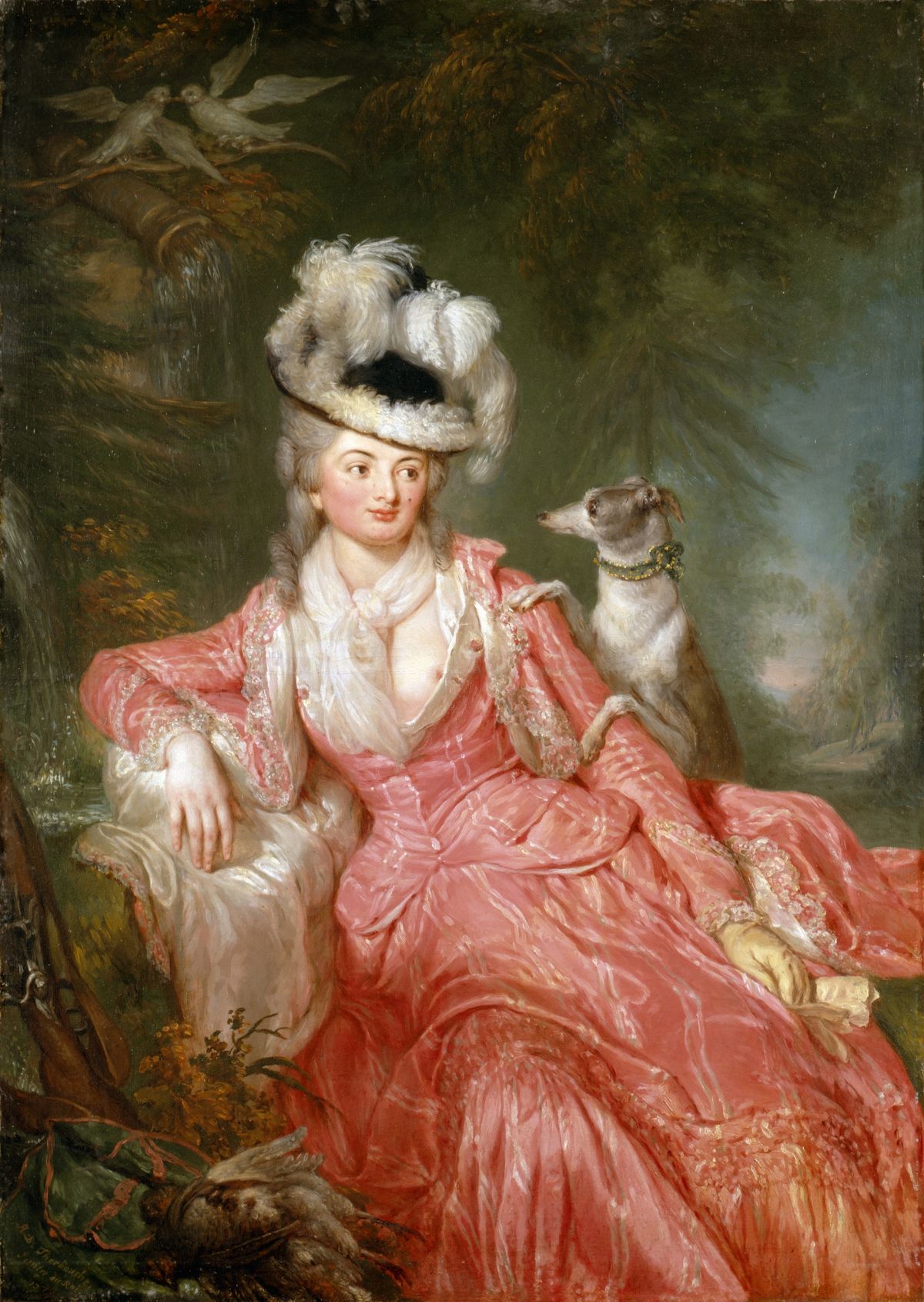
A quiver with arrows, a hunting dog, a rifle, and shot partridges: this painting seemingly portrays a female hunter - or does it? The young woman depicted by Anna Dorothea Therbusch in 1776 is Wilhelmine Enke, daughter of a 'Royal Chamber Musician' of Frederick II. Father Enke had assumed his position in Berlin in 1762, accompanied by his family, including the then 10-year-old Wilhelmine.
In Berlin, Wilhelmine crossed paths with the Prussian Crown Prince Frederick William, who was eight years her senior. Initially, he provided the young girl with an education before she became his mistress at the age of 16. At the time, Friedrich Wilhelm was divorced from his first wife, who had been just as unfaithful as he was, yet she faced the consequences unlike him. Friedrich Wilhelm proceeded to marry another woman but by no means bid farewell to Wilhelmine.
See also: 5 Facts About Royal Mistress Madame du Barry
Frederick William's uncle, Frederick II, harboured little sympathy for his nephew's conduct, and it wasn't until 1777 that he acknowledged the relationship between the crown prince and his daughter. This portrait, initially portraying Wilhelmine as a hunter, likely marked a milestone in gaining his acceptance. However, as indicated by the two doves above her, she was only on a quest for love, which she found in Friedrich Wilhelm, as she reclines back in a relaxed manner, even loosening her bodice for a rather intimate view. The dog resting on her arm can be seen as a symbol of the fidelity she has pledged to her lover.
Wilhelmine and Friedrich Wilhelm had six children together, yet only two of them survived infancy. Friedrich Wilhelm elevated both to the rank of count after he ascended to the Prussian throne in 1786. Although Wilhelmine was no longer his mistress by this time, she remained his closest friend and advisor, dedicated to advancing the arts and sciences in Prussia. In the mid-1790s, she embarked on a year-long journey to Italy. Upon her return, filled with numerous impressions and mementoes, she oversaw the expansion and redesign of the Marble Palace in Potsdam. Today, her portrait in a hunting ensemble can still be admired there.
See also: 5 Portraits of Women in Black
In 1796, she was ennobled as the Countess of Lichtenau. However, when Frederick William II passed away in 1797, his son and successor, Frederick William III, ordered an investigation into Wilhelmine for high treason. She was even temporarily incarcerated in a fortress. Deprived of all her belongings, she was expelled from Berlin, only permitted to return in 1809 under Napoleon's influence. She passed away in 1820 after spending her final years in rather modest circumstances.
Jean-Honoré Fragonard, The Swing, ca. 1767/68
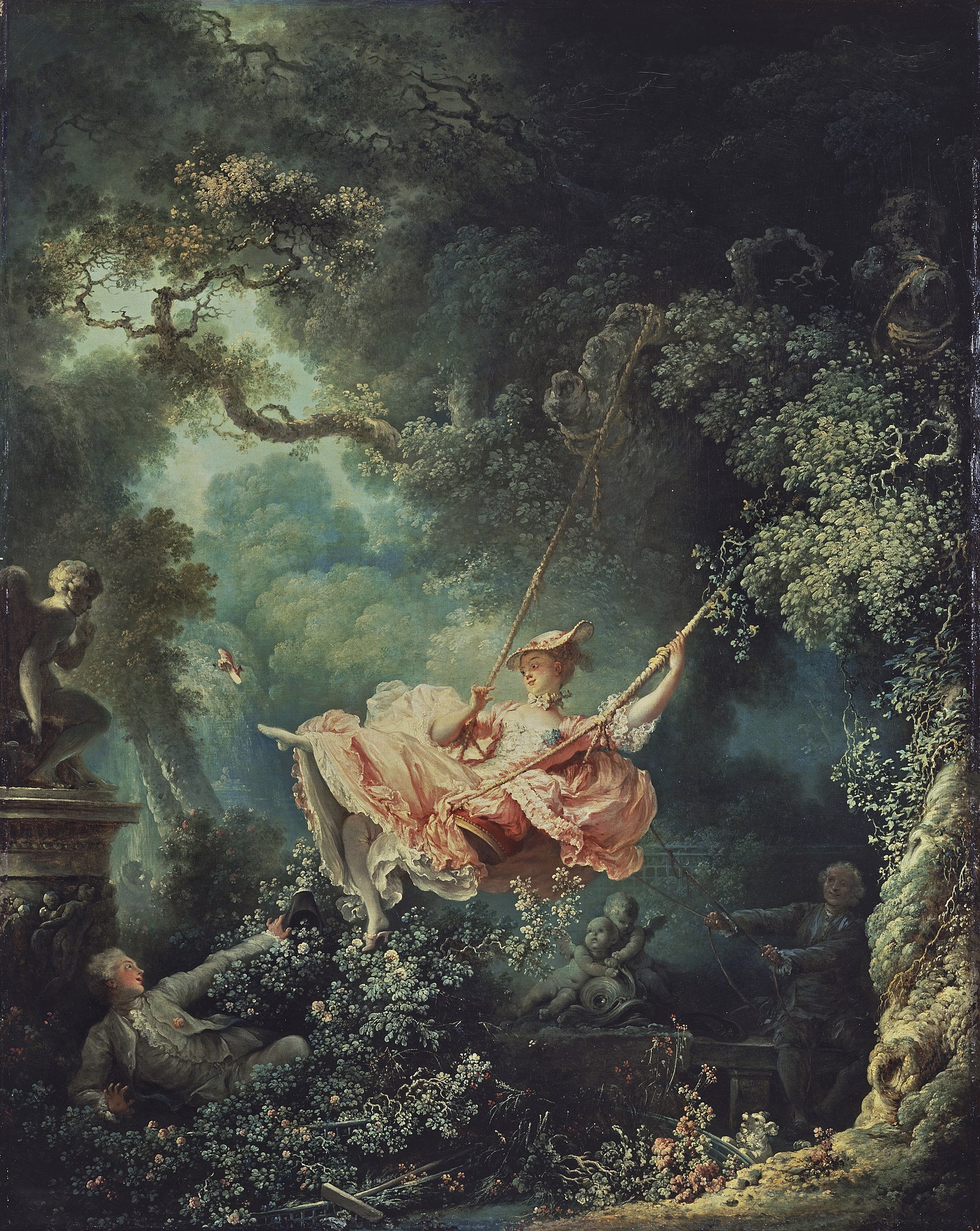
This painting also depicts a mistress, but unlike the previous portrait, her name remains unknown — unlike the painting itself, which stands as one of the most renowned examples of Rococo art.
It is also the most renowned work by its creator, the French painter Jean-Honoré Fragonard, who was undergoing a transitional phase in his career at the time, shifting from history painting to the genre of lighthearted salon painting. According to the accounts of the playwright Charles Collé (the sole available source), an unnamed courtier wanted a portrait featuring himself and his mistress. He envisioned her seated on a swing, propelled by a bishop, while he himself enjoyed the view of her shapely legs. Initially, he approached the history painter Gabriel François Doyen for the commission, but Doyen declined, deeming it too frivolous, as he was striving to establish his reputation with religious themes.
Now Fragonard stepped in, likely interpreting the commission as a signal to persist in his newly chosen direction. The outcome was quintessential Rococo, replete with sensuality and contradiction. Despite the delight expressed by the young man, who reclines backward into the bushes while stealing a glance beneath the billowing skirts of the swaying woman, the scene is juxtaposed with Falconet's L'amour menaçant ('Menacing Love').Fragonard, however, found himself unable to accommodate the requested bishop and instead substituted him with an older gentleman.
See also: Seeing Double: Art in Art
According to the unknown patron, François-Marie Ménage de Pressigny, a tax collector who met a grim fate during the French Revolution, was the first documented owner of the painting. It arrived in England in 1865 through Richard Seymour-Conway, 4th Marquess of Hertford, and is currently housed in the Wallace Collection in London.
Édouard Manet, A Young Lady in 1866, 1866
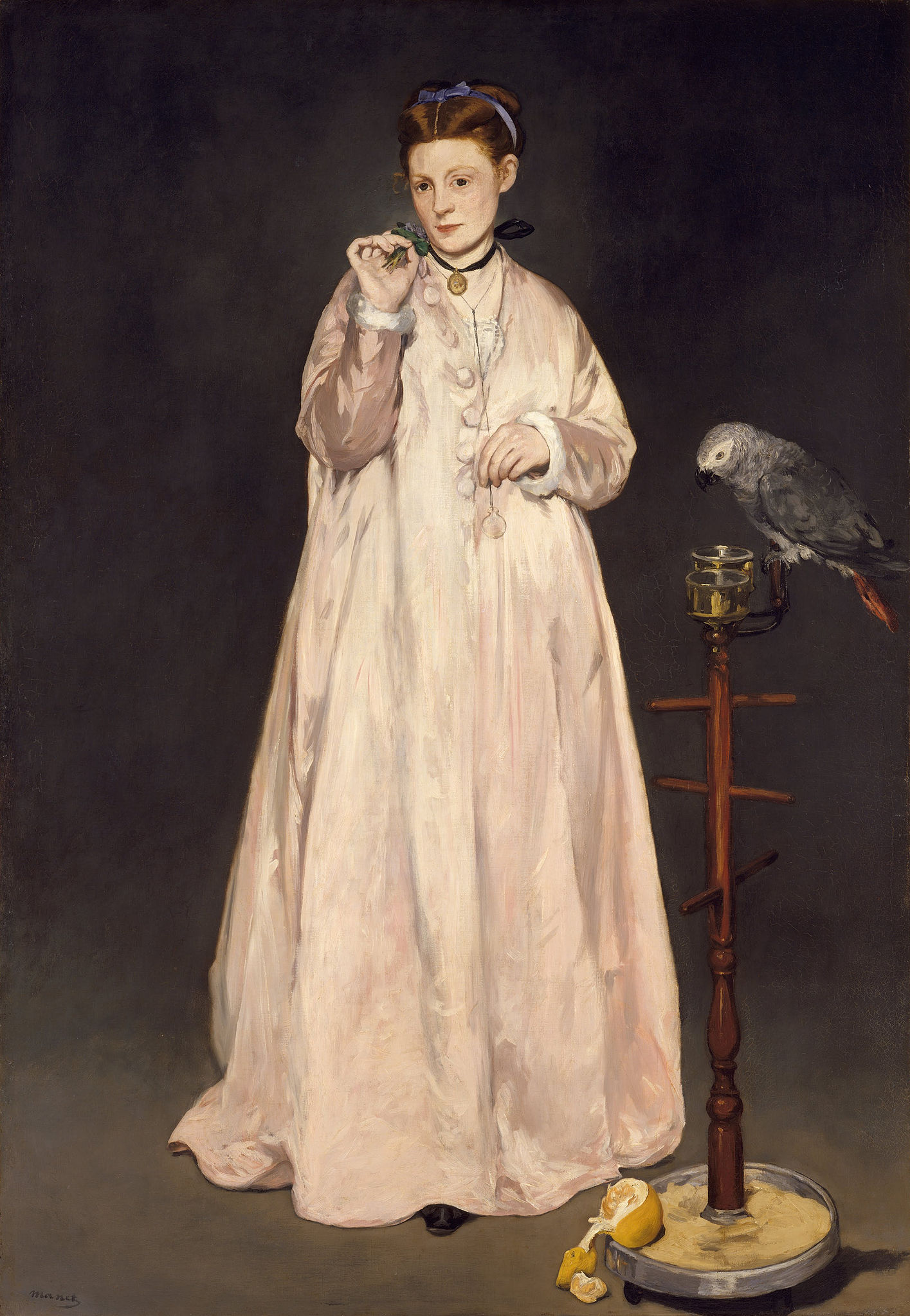
In 1862, the 18-year-old Victorine Meurent caught the eye of Édouard Manet with her copper-coloured hair and petite frame. Meurent had already posed for the painter Thomas Couture by this point, and now Manet also sought to immortalise her youthful allure on canvas.
Manet painted portraits of Meurent, portraying her in a grey dress as a street singer and even donning trousers as a bullfighter. Then, the covers came off, and the resulting two paintings caused a scandal in 1863. We're referring to Breakfast on the Grass and Olympia, both of which feature the nude Meurent in the role of a courtesan. Unlike traditional depictions with mythological Venuses or biblical Susannas that might 'justify' such bold nudity, there was no such pretext here. There was also no hint of shame or averted gaze; the protagonist stares directly at the viewer.
See also: 5 Portraits of Women in White
After this tumultuous period, Manet clothed Victorine once again in 1866, this time in a floor-length dressing gown, and positioned a grey parakeet beside her. However, the piece received a rather negative reception when it was exhibited at the Salon of 1868. It was unfavourably compared to Gustave Courbet's painting Woman with a Parrot, also completed in 1866, which had stirred controversy due to its overtly revealing nudity. Despite Manet originally titling his work Woman in Pink, Young Lady, or A Young Lady in 1866, it was subsequently dubbed Lady with a Parakeet in reference to Courbet's piece.
See also: The 10 Most Scandalous Artworks
Recent research has explored the notion that Manet's painting might symbolise the five senses: Hearing (represented by the parakeet), smelling (the bunch of violets), tasting (the orange), and seeing and feeling (the monocle on a string).
Franz Xaver Winterhalter, Portrait of Charlotte of Belgium, 1864
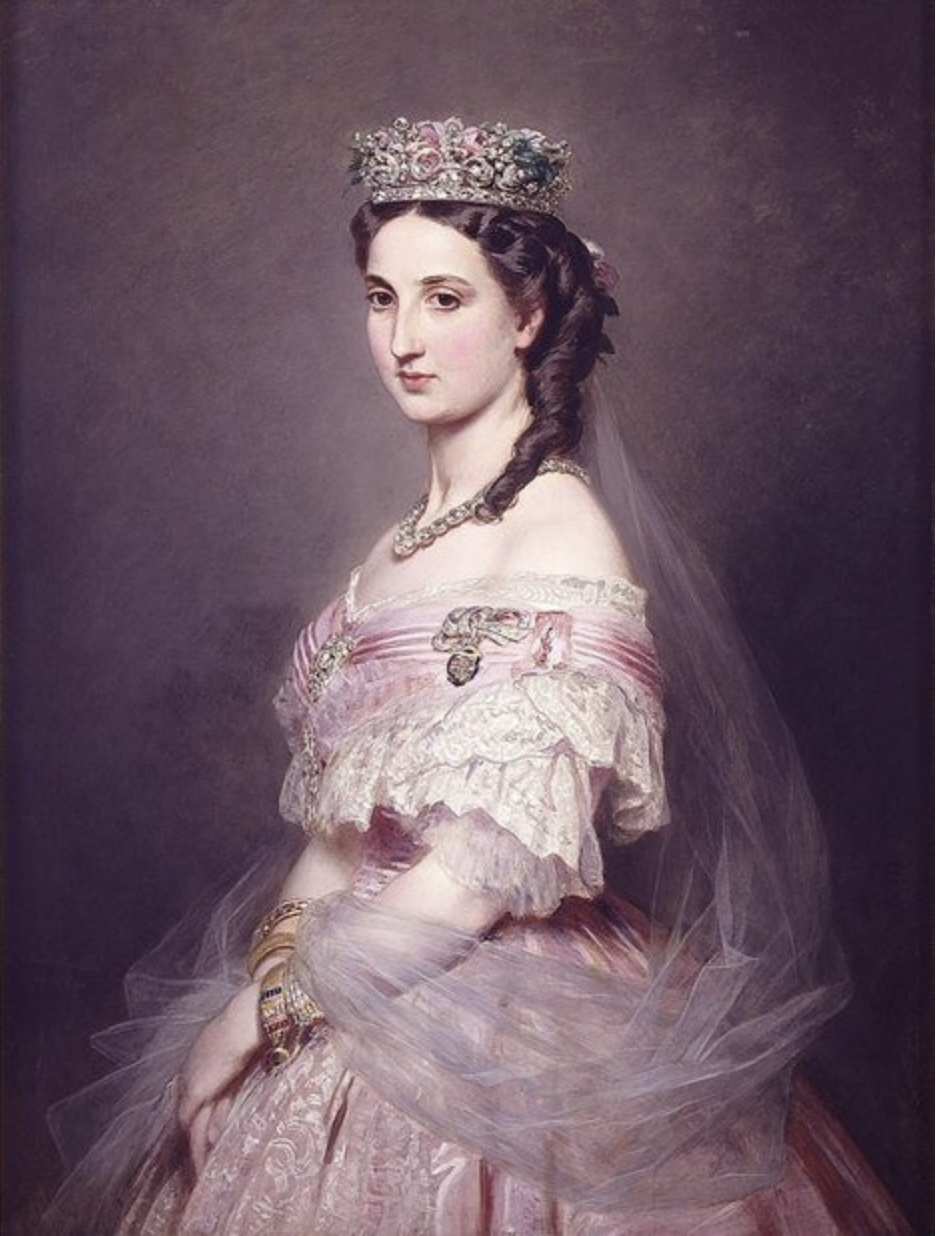
In 1857, the imperial family in Vienna celebrated as Ferdinand Maximilian, one of Emperor Franz Joseph I's three younger brothers, returned with his newlywed wife. Charlotte was the sole daughter of Leopold I, King of the Belgians, and aside from a fine education and striking beauty, she also brought an immense fortune into the marriage. Maximilian could only be delighted by the latter, as by his mid-twenties, the often dreamy bon vivant had already accumulated a significant mountain of debt.
See also: 5 Famous Women in Red
In Vienna, Charlotte was generally welcomed with enthusiasm, except by one individual in particular: Empress Elisabeth. Indeed, the two women couldn't be more different in character. Unlike the reserved Elisabeth, Charlotte thrived on the allure of courtly spectacle. Charlotte also took pride in her royal lineage, whereas the empress hailed from a lesser-known branch of the Bavarian dynasty. Court society, which had always viewed Elisabeth with skepticism, clearly favoured Charlotte. In terms of appearance as well, Charlotte occasionally outshone her sister-in-law, whose legendary beauty was still developing.
See also: Beauty is Truth: A Real Portrait of Empress Elisabeth of Austria
However, Elisabeth didn't have to endure the presence of her disliked sister-in-law in Vienna for too long. Charlotte accompanied her husband to Trieste, where he served as commander-in-chief of the Austrian navy and, meanwhile, as governor of Lombardy-Venetia. They resided together in the splendid Miramare Castle, perched directly on a rocky cliff overlooking the Adriatic Sea.
Life could have been idyllic and peaceful for Charlotte and Maximilian if not for their shared ambition. Both felt called to grander pursuits, and when French Emperor Napoleon III offered Maximilian the imperial crown of Mexico, then under French occupation, in 1863, they departed for their new empire the following year. However, their European imperial presence was not universally welcomed. Notably, the previously deposed President Benito Juárez still commanded considerable support.
Want more articles like this straight to your inbox? Subscribe to our free newsletter!
When France withdrew from Mexico two years later, Maximilian and Charlotte found themselves in dire straits. While Maximilian struggled to maintain his precarious throne, Charlotte journeyed to Europe in search of aid, first from Napoleon III and then from the Pope, but her efforts were in vain. She suffered a nervous breakdown and descended into madness following Maximilian's execution on 19 June 1867. Declared insane, she spent the final 60 years of her life in seclusion at a castle in her native Belgium.

![Antoniucci Volti, ‘Les Parisiennes’ [detail], 1962, bronze proof with blue-black patina, height 146cm. Photo © HVMC](https://images.prismic.io/barnebys/8edc2a1c-0b58-48ed-95d6-6192c140c702_Cover.jpg?auto=format,compress)