Join Pax Romana for their summer sale of spectacular antiquities and ancient art from across the world. Taking place on 26 July, the breath-taking catalogue features Egyptian antiquities, ancient weaponry, such as helmets and swords, ancient jewellery which has been examined by an independent gemologist, and TL-tested Chinese terracotta. Here is a selection of six highlights.
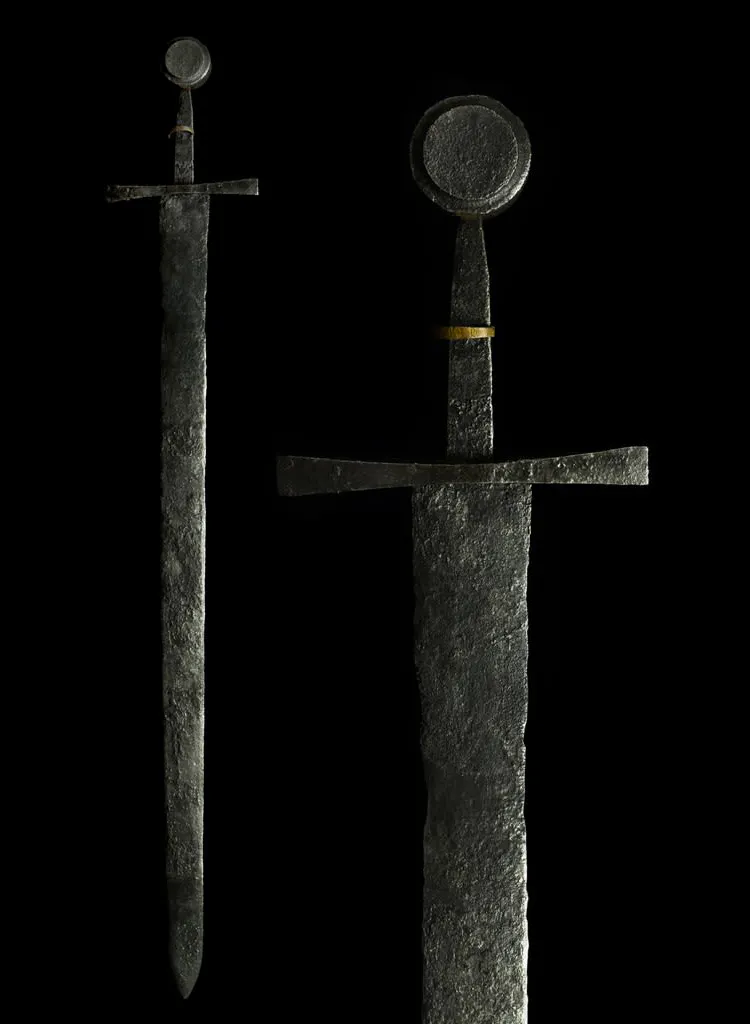
From c. 1200-1300 AD is this stunning, forged-iron long sword with a long hilt and a flat disc pommel. The High Middle Ages saw swordsmiths develop new types of blades to combat the ever-increasing usage of plate armour. Against these defences, early-styled swords with light, flat cutting blades lost much of their effectiveness. Warriors and craftsmen of the day saw the need for more acutely pointed blades with cross-sections reinforced for thrusting. Mounted on a custom-made stand, this sword is in excellent condition.
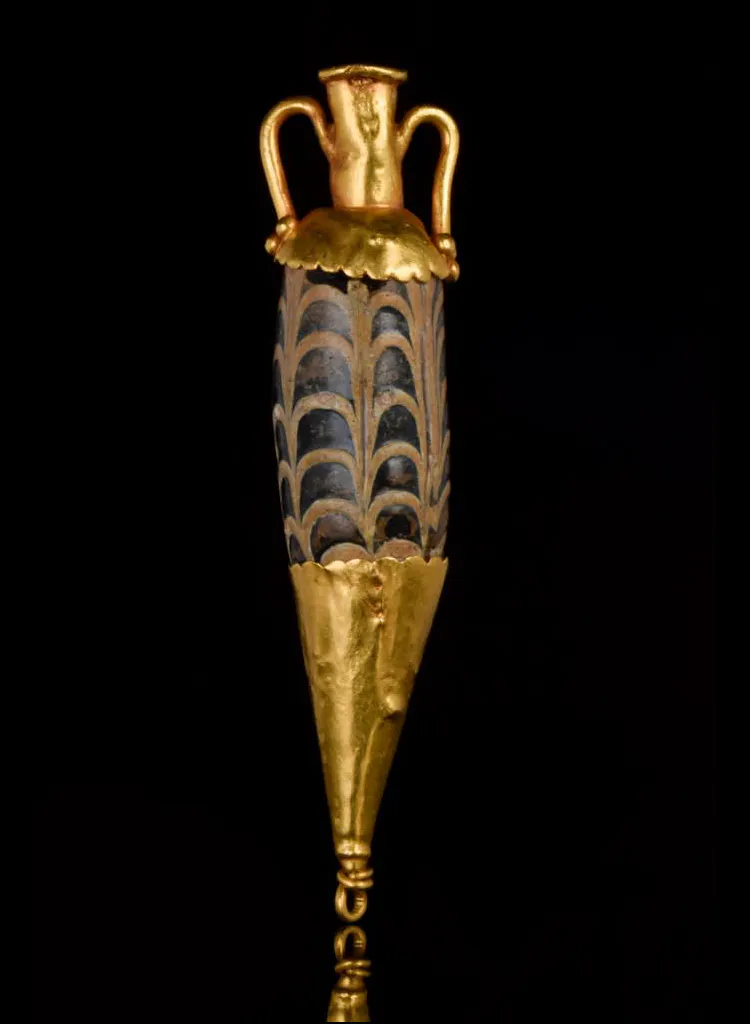
This rare Hellinistic pendant, from c. 300-100 BC, is in the shape of an amphoriskos – amphoriskoi (from Greek, ‘small amphorae’) were small jars with two handles that were used for perfume or toilet oil in Greek and Roman times.
The body of this amphoriskos pendant is made of dark glass decorated with a fish scale decoration pattern in a dark gold colour. The lip, neck, handles, shoulder and lower body of the amphoriskos are made of gold, and a loop is attached at the bottom of the amphoriskos in place of the foot. The item has undergone X-ray fluorescence analysis to confirm the metallurgical content suggesting its ancient origin and lack of modern trace elements.
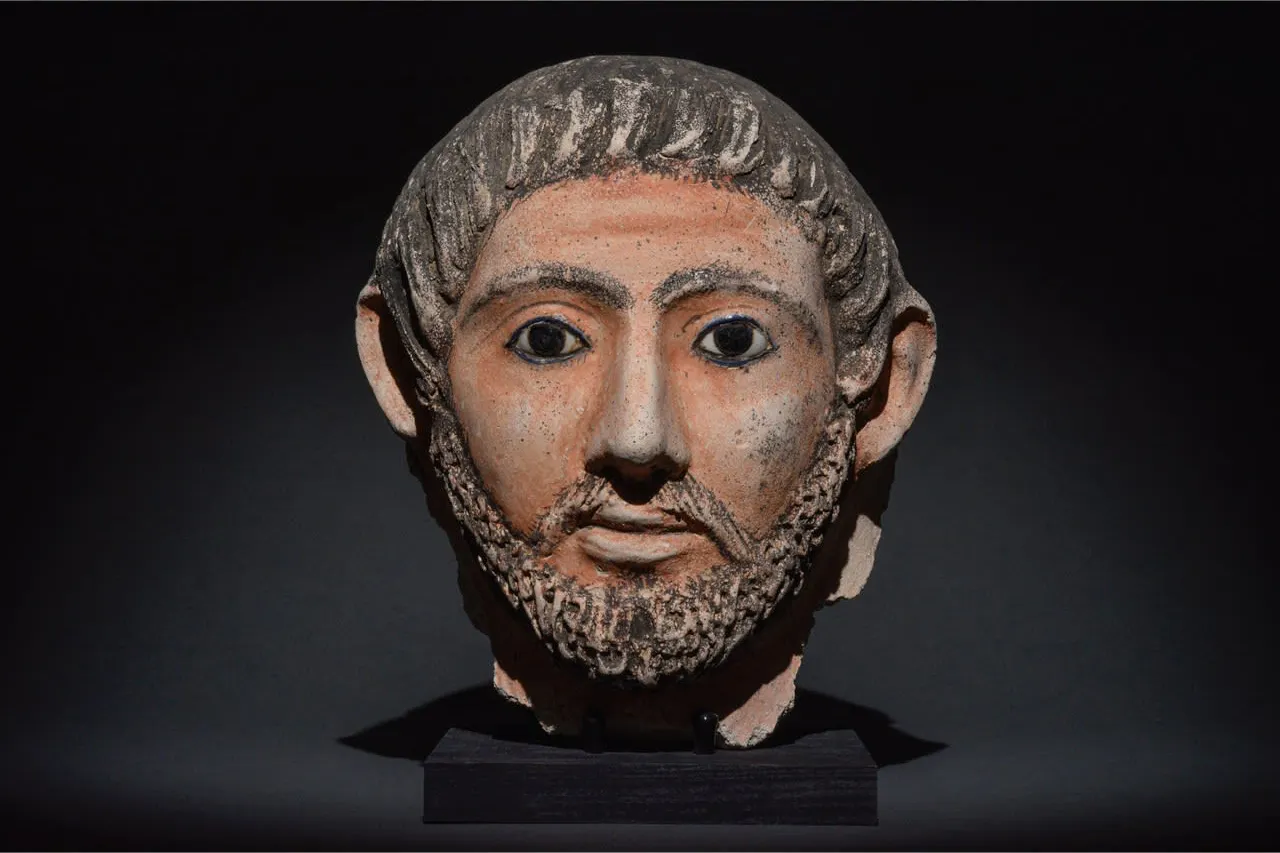
From c. 323 BC-395 AD, the Graeco-Roman Period, is this Greco-Egyptian ceramic head of a man. The piece is stunningly life-like: the man is depicted with wavy locks, a short curly beard and eyebrows painted black, while his skin is a red-ochre colour. His eyes are inlaid with black-and-white glass giving them a reflective quality, and they are outlined with blue for the kohl. Delicate strokes depicting the eyelashes descend from the eyes, drawing more on Hellenistic art than Egyptian.
The rear was not made to look like the back of a head as one might expect in a free-standing statue, and instead this was attached at the back to some other ceramic form – the nature of which is not certain, as it has been broken off. The break leaves an area visible where the hair is attached to a ceramic structure decorated with lines and geometric patterns. One possibility is that this was part of a ceramic vessel of a Cypriot type, which depicted a modelled face on the side of the container. Cyprus was long an important part of the Ptolemaic Empire and it was geographically situated very close to Alexandria, so several such vessels have been found in Egypt. Whether this means they were imported from Cyprus or their style was adopted by craftsmen within Greco-Roman Egypt is still debated.
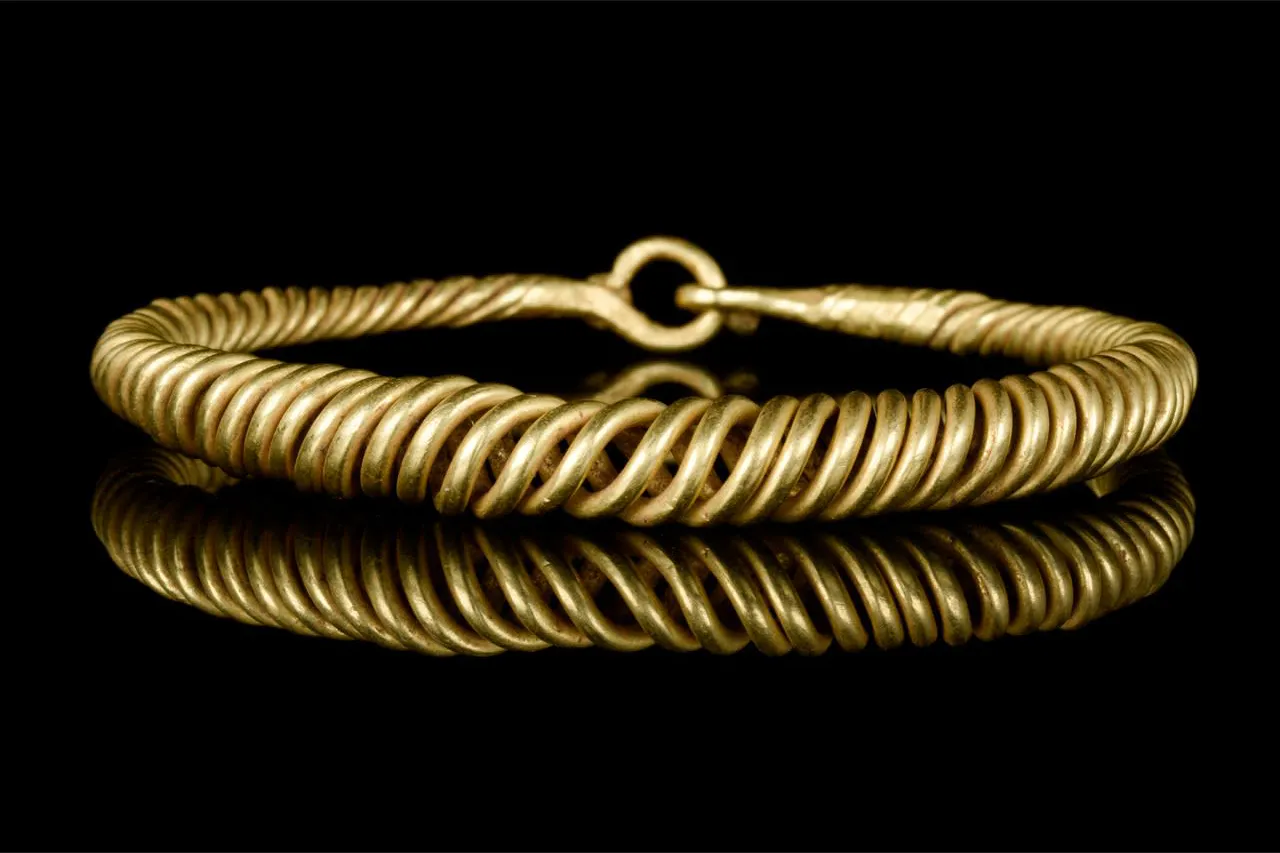
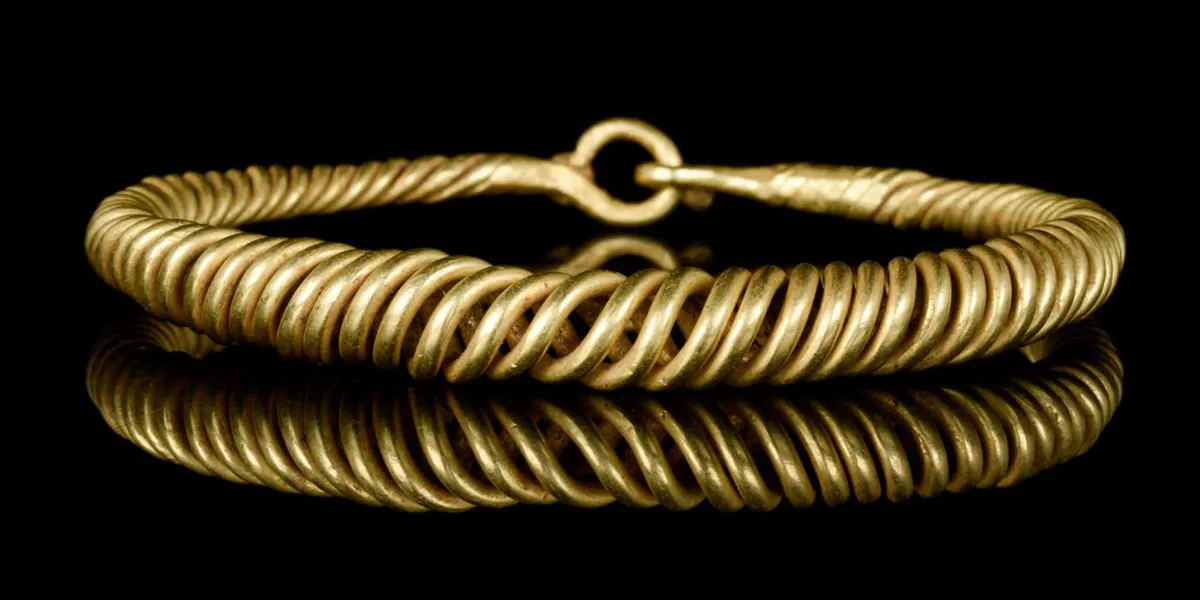
This rare, Roman gold bracelet from c.100-200 AD, is made of thick, twisted gold wires with a hook clasp. Jewels were particularly important for Roman women because they were their own property, and not their husbands’. Thus, women could buy, sell, and bequeath their jewellery as they saw fit, sometimes melting down older pieces to create an updated style and even using jewellery to settle family debts.
Women's jewellery also served as a visible symbol of their wealth, illustrated by the Roman 'Lex Oppia', which was enacted in 215 BC during the Second Punic War. This wartime legislation restricted the amount of jewellery that a woman could wear to half an ounce of gold, with the understanding that the rest would be contributed to the treasury for the protection of the state. After the war, Roman matrons led public protests that prompted the repeal of the Lex Oppia in 195 BC, and lavish jewellery was once again in fashion.
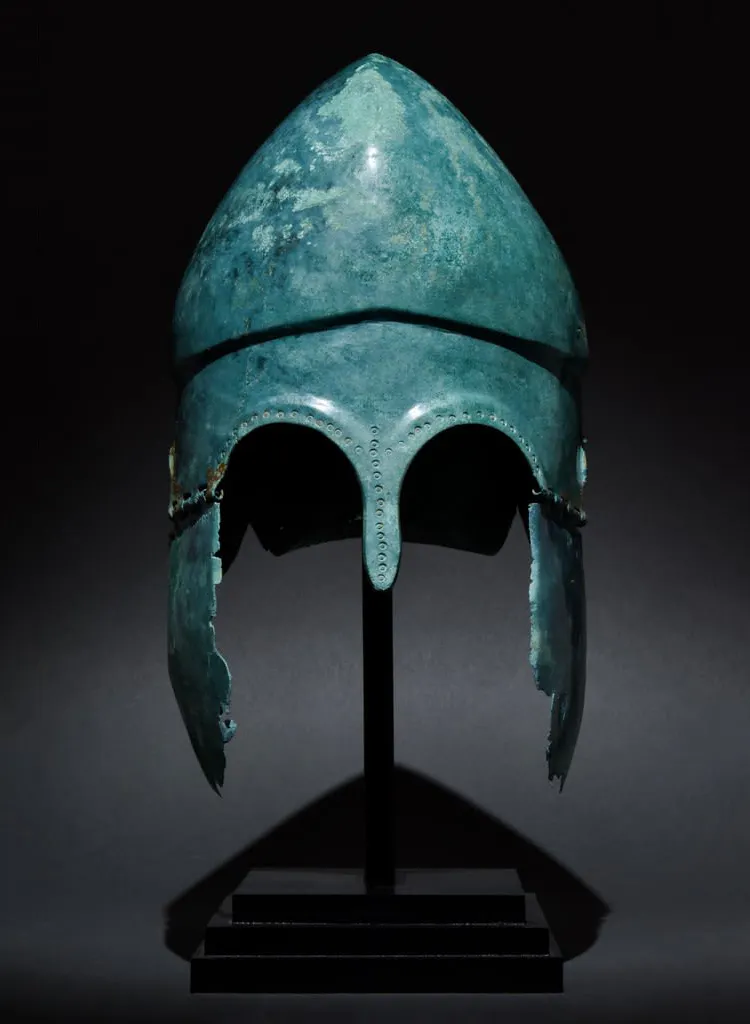
The bowl of this 500-300 BC Chalcidian helmet is forged in one piece, featuring high-arched eyebrows with an ear drop-shaped nose guard and a flaring neck-guard.
Chalcidian helmets are named after similar helmets depicted on pottery vases from the Euboean city of Chalcis. This type of ancient Greek helmet was a lighter and less restrictive form of the Corinthian helmet. The hinged cheek pieces were anatomically formed to fit closely to the face and tended to curve upwards towards the eye, where large, circular openings provided a wider field of view than the Corinthian helmets.
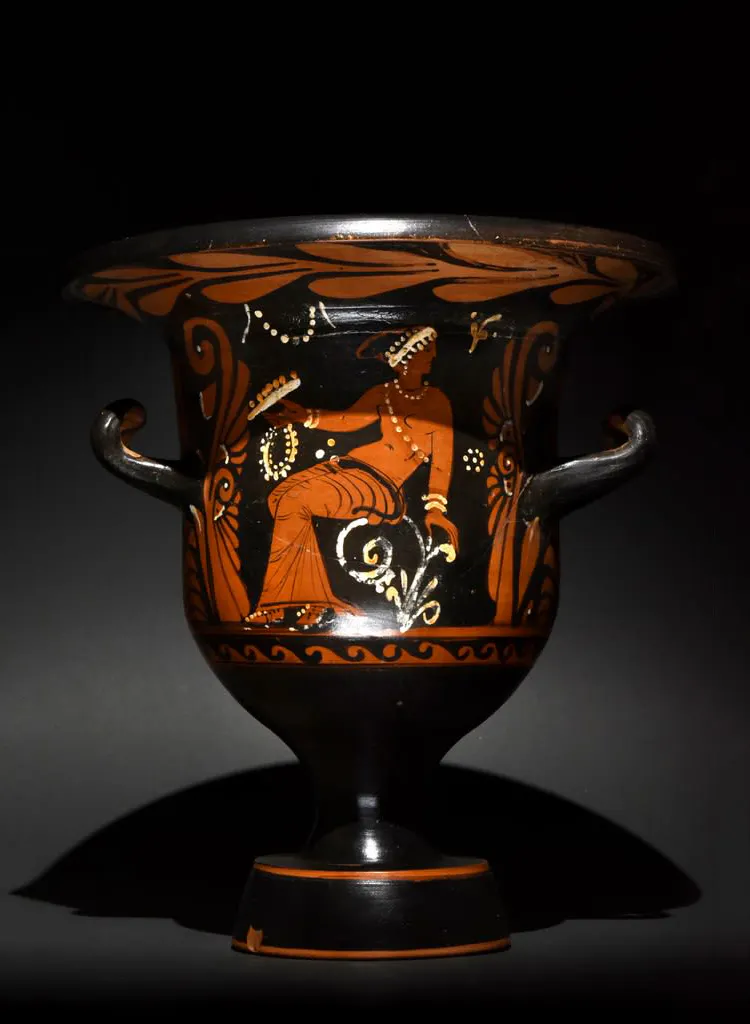
Lastly, we have this 400-300 BC Apulian terracotta bell krater, which features a pedestal foot, cylindrical flared stem, inverted bell-shaped body, two upturned handles and a wide, everted rim. One side of the body's decoration depicts a laureate, nude male holding a musical instrument, his left arm resting on his left thigh. The male figure is not the god Dionysos himself, as he lacks the traditional iconographical attributes of the god (the thyrsos – a pine-cone tipped staff – a drinking-cup also known as kantharos, or a wreath of ivy-leaves), but the scene may be part of a Dyonisiac thiasos, the procession of Dionysus followers, often pictured as inebriated revellers. This interpretation is supported by the iconography of the other side of the vase's body, which depicts a half-nude, crowned and seated woman holding a phiale ready for wine to be poured into and a tambourine for entertainment.
The figures are flanked by a palmette design beneath each handle. The use of white paint for additional details, such as the jewellery of the woman and as added highlights to the scenery, is indicative of this vessel having been painted in Magna Graecia (the Greek colonies of Southern Italy). Bell kraters such as this example first occurred in the early fifth century and the only extant ones have red-figure decoration. Bell kraters were named for their bell-like shape, perhaps originating in wood, and usually featured small horizontal upturned handles just over halfway up the body, as in this example. Kraters were used for diluting wine with water and usually stood on a tripod in the dining room, where wine was mixed during a banquet (symposium).
Pax Romana’s ‘Antiquities and Ancient Art’ auction is taking place on 26 July, and the 418-lot catalogue is ready for viewing now.