
Mention the early Renaissance and the Italian artist Giotto is frequently the first who springs to mind as a pioneer of the movement. However, a key figure who is often underestimated in this art history timeline is Giotto’s teacher and fellow countryman, Cimabue.
The painter and mosaicist known as Cimabue, real name Cenni (Benciviene) di Pepe, was born to a noble family in Florence, Italy in 1240. This was during the late Medieval period, when art was heavily influenced by the Byzantine style – the art of the Eastern Christian empire – and focused on religious iconography which tended to be flat, two-dimensional depictions of Biblical scenes. But over the course of his working life, Cimabue was to set in motion the beginnings of a stylistic sea change that would transform the art world and beyond.
See also: Here Are The Gothic Painters You Should Know
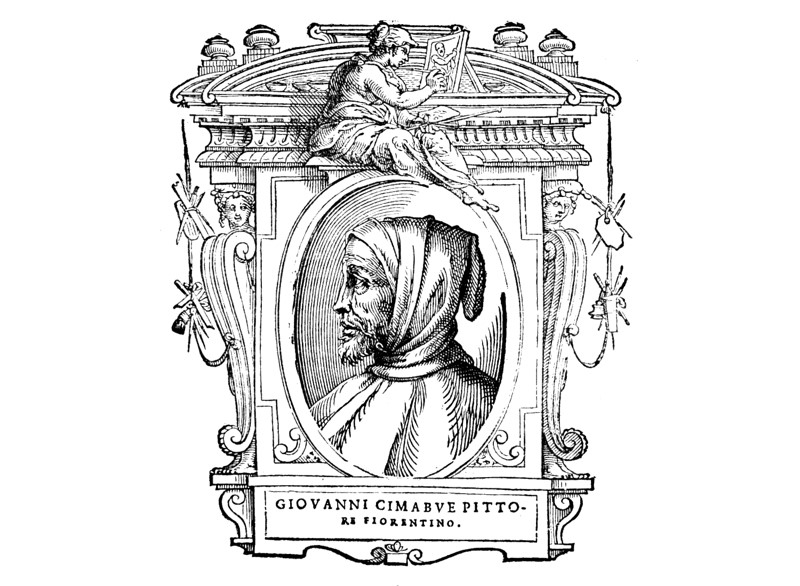
Not much is known about Cimabue’s formative years and there is virtually no official documentation of his work. Biographical details vary but most can be traced back to one book, published in 1550: The Lives of the Most Excellent Painters, Sculptors, and Architects by Giorgio Vasari, an artist and writer widely regarded as the world’s first art historian.
See also: A New Renaissance for Old Masters
According to Vasari, the young Cimabue showed a talent for drawing while a pupil at the Santa Maria Novella convent school. Instead of diligently reading his text books, it seems Cimabue preferred to sketch figures and animals on the pages. So much so that when Greek artists arrived in Florence to decorate the convent church, his parents allowed him time away from school to study their work – an experience which may have begun to shape his artistic awareness. Vasari was a great admirer of Cimabue’s work, writing that "he surpassed by a long way those Greek painters."
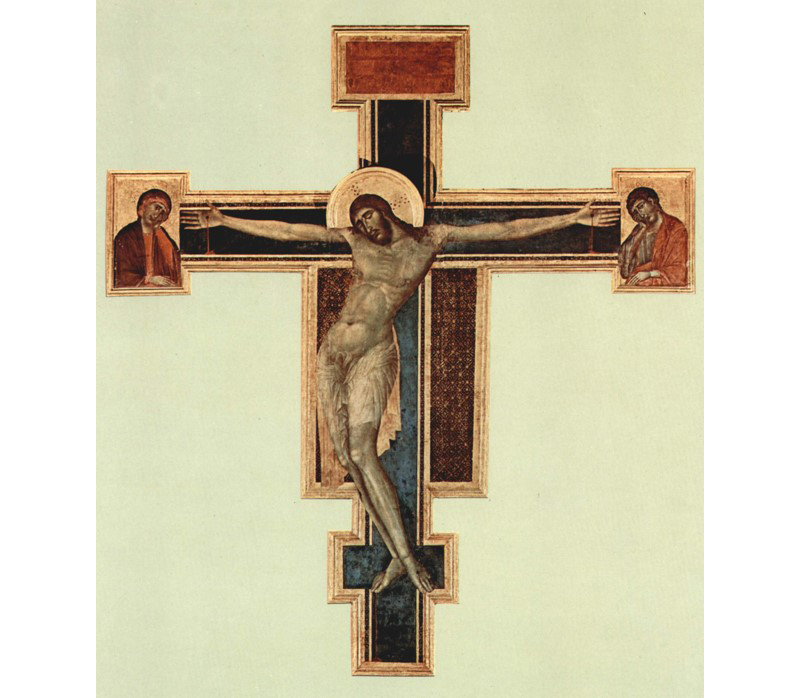
In a marked departure from the schematic methods of his contemporaries, Cimabue’s paintings portrayed naturalistic human forms, such as lifelike facial features and indications of musculature.
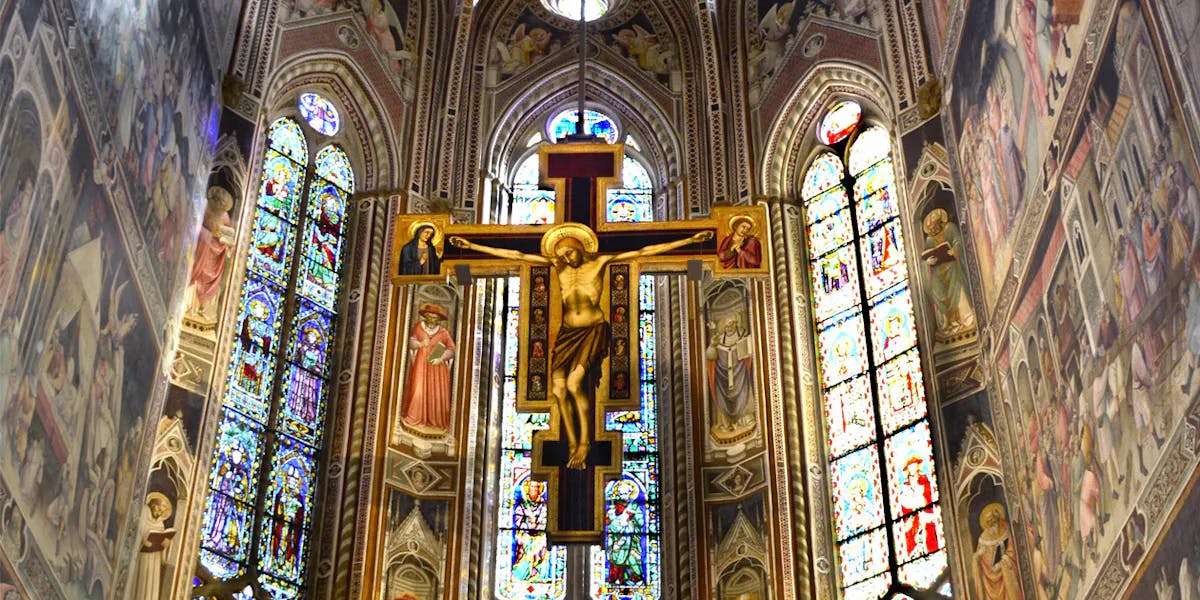
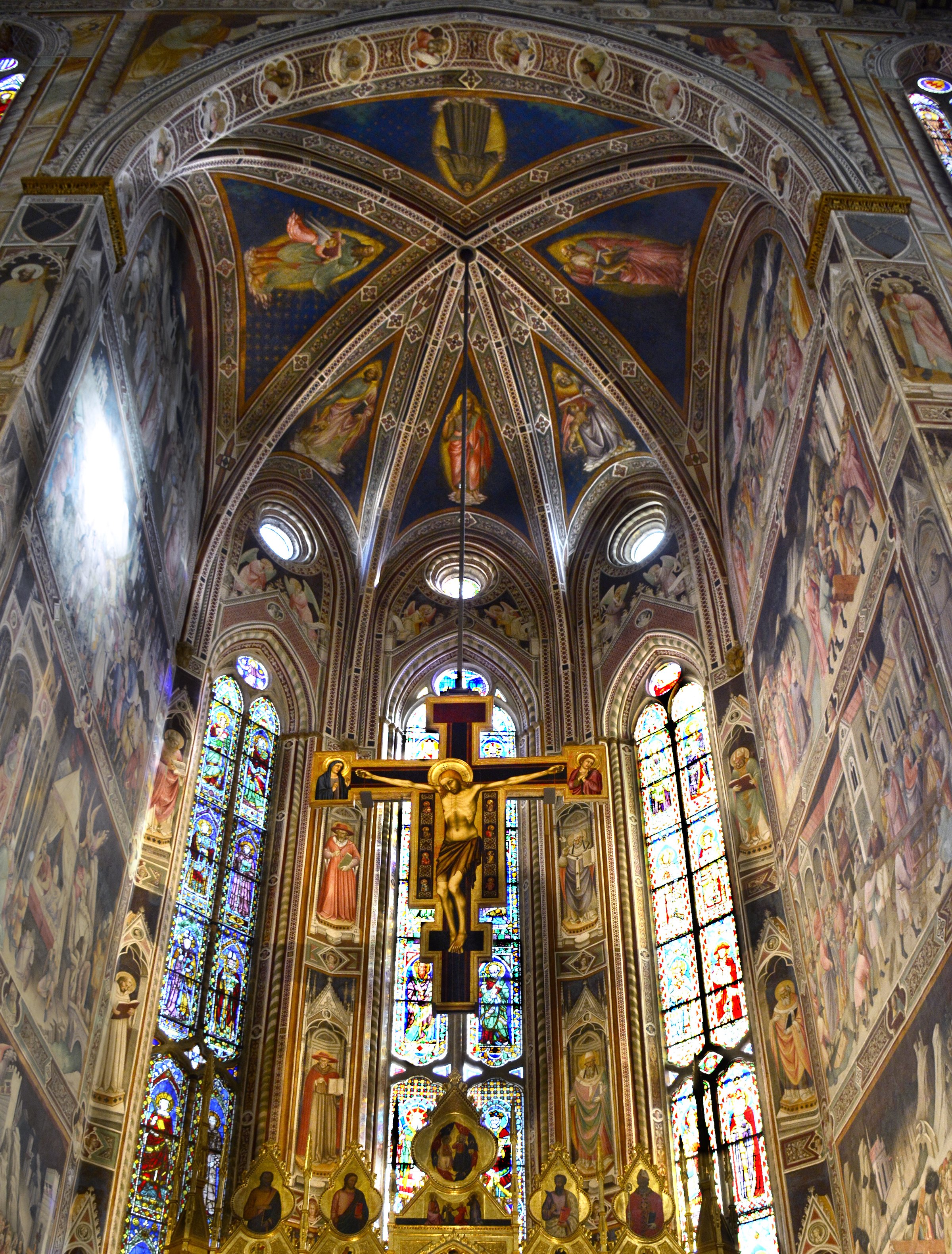
These qualities can be seen very clearly in the Crucifix at the Basilica di Santa Croce, Florence (c.1287-88). The realistic slump of Christ’s body, together with the strain of his outstretched arms, graphically depicts human suffering, far removed from the stylized, expressionless iconography of the time. Moreover, the folds of cloth and the way in which the hands and feet protrude beyond the cross provide an albeit basic, three-dimensional effect.
See also: Christian Iconography in Art, Explained
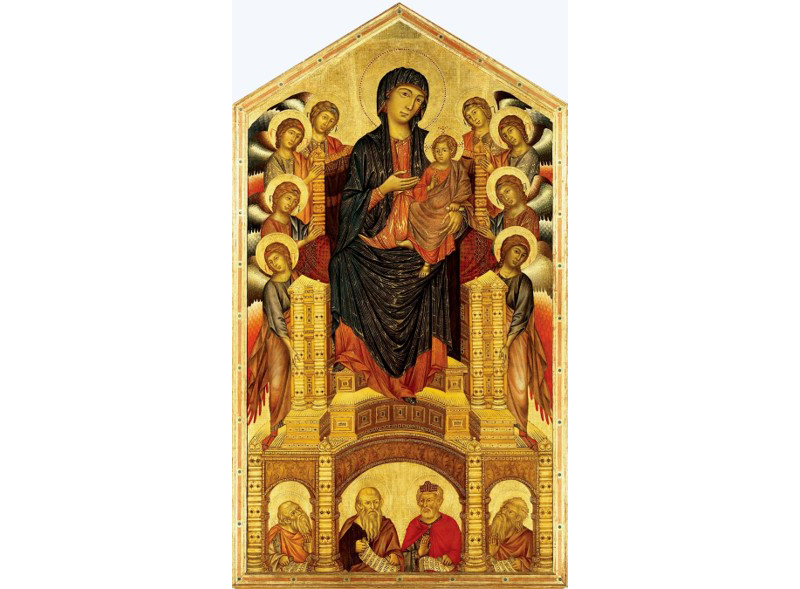
Likewise, in Santa Trinità Madonna (c. 1290) Cimabue offers the viewer an abundance of rippling cloth to create depth and an illusion of perspective which works particularly well in the center of the image.
Throughout his career, Cimabue’s work took him as far north as Bologna, west to Pisa, east to Assisi and south to Rome, but it was in his hometown of Florence that he discovered his protégé – Giotto di Bondone.
See also: Tintoretto: The Venetian Virtuoso
According to Vasari, Giotto was a young shepherd boy whose lifelike drawings of sheep on a rock were noticed by Cimabue. Impressed by the youth’s artistic prowess, he hired Giotto as his apprentice. Another tale recounts that when Cimabue left his workshop one day, the young Giotto painted a fly on his master’s picture. The fly was so realistic that when Cimabue returned, he tried to brush it off the painting.
Many of Vasari’s stories are anecdotal and his dates contradictory: for example, he states that Cimabue died in 1300, but later records show that in 1302, he was still alive and working in Pisa.
Inconsistencies aside, one thing Vasari was unequivocal about was his admiration of Renaissance art. Vasari was also from Florence and, as such, was an unabashed proponent of Florentine artists in particular – prompting suggestions by later historians that his unwavering praise of Florentine art contributed to the superstar status of Michelangelo and Leonardo da Vinci.
See also: Leonardo da Vinci: Universal Genius
As far as Cimabue’s status is concerned, he is reputed to have possessed a somewhat prickly and proud disposition. If someone criticised his work, or if he himself found fault with it, he would destroy the piece. This fit with his nickname, as 'Cimabue' comes from the Italian, 'cimare,' or 'blunt,' and can be translated as 'ox head,' or perhaps even 'bull headed.'
In terms of legacy, it is unfortunate that Cimabue tends to be remembered more for being the teacher of Giotto than an artist in his own right. Despite Vasari’s claim that Cimabue gave "the first light to the art of painting," he later concluded that Giotto "truly eclipsed Cimabue’s fame just as a great light eclipses a much smaller one."
This is a view supported by the poet Dante who, in Canto XI of his Purgatario, wrote:
In painting Cimabue thought he held
the field, and now it’s Giotto they acclaim—
the former only keeps a shadowed fame.
On the other hand, Victorian art critic John Ruskin believed Cimabue to be Florence’s finest painter, with talent equalling that of Tintoretto and Michelangelo. He suggested that it was only because he was the first in a series of artists who laid the foundations for the Renaissance that his contribution and impact have been eclipsed by those who followed. Ruskin added, "It is so with all great men: they rise to greatness on unknown stepping-stones."
See also: Michelangelo: From Man to Genius
Want more articles like this straight to your inbox? Subscribe to our free newsletter!
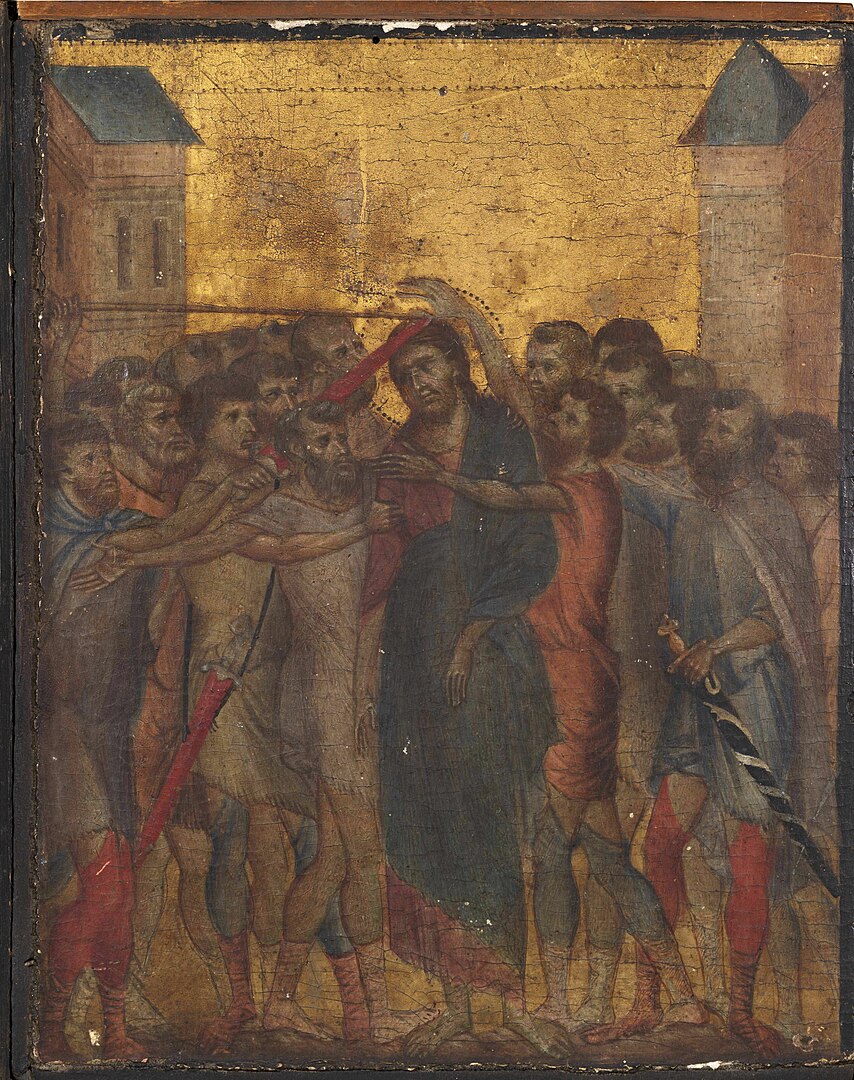
Cimabue’s name hit headlines in October 2019 when an artwork attributed to him sold for a record price of $26.6 million at auction. Christ Mocked, an unsigned painting depicting the final stages of Jesus’s life, fetched four times more than expected at the sale, its original estimate being €4-6 million.
The small wooden panel is thought to be part of a polyptych – a collection of scenes painted across several panels – dating from 1280 and depicting Christ's passion and crucifixion. The panel was in excellent condition, despite having been hung on a kitchen wall, above a hotplate. It was discovered quite by chance, thanks to an auctioneer who was at a house in Compiègne, France to value furniture. The masterpiece was acquired by the Louvre in November 2023.
See also: The Louvre Acquires the "Kitchen Cimabue"
Two other scenes from the same Cimabue series are in public collections – Virgin and Child at the National Gallery in London, and The Flagellation of Christ at the Frick Collection in New York.
Article by Kay Carson
Discover more articles on Barnebys Magazine
This is an updated version of the article originally published on 9 April 2020.