
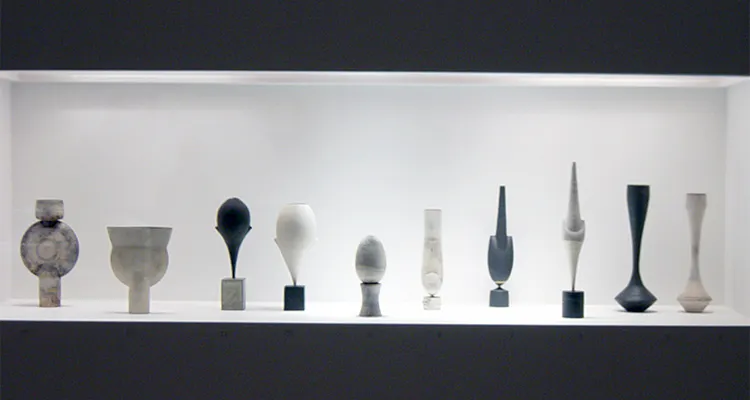
Yet those days are declining, contemporary ceramics is now being taken seriously as an art form with major dealers and collectors buying the works of Lucie Rie, Hans Coper, Edmund de Waal and many other potters at ever increasing prices and housing and positioning them aside and against works by major global artists.

The propulsion of the whole market has been fuelled by the ever increasing demand for the work of Rie and Coper, two early 20th Century emigre ceramicists, who settled in Britain and developed a new sculptural form of ceramic art closer to European and Bauhaus traditions than the Leach and Cardew school centred on the Japanese aesthetic which had been predominant in the earlier half of the century.
Coper particularly ashrewed the craft tradition led by Bernard Leach and in the 1950s he reacted to the work of Lucie Rie, who he worked alongside at her Pottery in Albion Mews after the war, but was left unmoved and uninfluenced by other modern potter's of this generation. Coper saw himself as a sculptor as much as a ceramic artist and his greatest influences were the great modernist artists Giacometti and Brancusi.


In other potter's workshops of his generation forms were thrown in one, and the art of throwing was seen as of the utmost important skill. Coper created works by forming together separately thrown items and conjoining them skilfully and harmoniously to create sculptural forms of beauty the power coming from the balanced tension he created in each work. They are now sought out by engaged and knowledgeable collectors as the epitome of the medium and prices reflect this, as the best and most important examples can make upwards of £100,000.

Lucie Rie's work has similarly escalated in price and demand, although she did receive aesthetic and pubic acclaim in her lifetime with retrospectives of her work at the Arts Council (1967), a Damehood in 1991 and alongside works by Coper had a show at the Metropolitan Museum of Art in New York (1994-5).

Rie's work focussed on delicate and spare aesthetic lines, textured surfaces, and interesting coloured glazes, not appreciated by many of the leading commentators of the period including Bernard Leach who advised her that her pots were too thin and did not clearly show the hand of the potter as no potting rings were obviously visible. Her ceramics are often angular and thin-walled, sometimes decorated with thin sgraffito lines and seem impossibly delicate showing the clear influence of the modern continental aesthetic. However, they are modern, timeless and beautiful objects clearly showing the hand of a master artist at work, and they are now espoused alongside the work of Coper as works of the highest quality by the foremost masters of this artistic form.


They inspired generations of new ceramic artists laying the foundations of the modern movement that we see today. What is interesting to see is that the work of leading contemporary artists influenced and inspired by Coper and Rie have also started to gain traction in the art market in the last 12 months. Notably works by Rupert Spira, Emmanuel Cooper, Jennifer Lee and Edmund de Waal, which all clearly show the influence of Rie, have seen spikes in there prices that shows no sign of abating. This will clearly be an interesting market to watch over the next 12 months and I expect some surprises for works by these artists and beyond.