Are you planning your estate or division of assets? Have you recently inherited an object or collection? Clearing out the attic? Here's how you can find out what your artworks, antiques and other objects are worth.
What is a valuation?
Knowing the value of your items is always useful, whether you are in the selling process, need to insure something or if you're simply curious. If selling at auction, knowing the current market value of your items is always the first step. Interested sellers have several options they can choose to learn more about their objects’ value – including free valuation services, such as stopping by their local auctioneer – but few of these options are quite as comprehensive as ValueMyStuff, a company owned by Barnebys Group. Using a premium valuation service like ValueMyStuff keeps sellers informed about what prices they can expect to achieve in the auction room.
Comparing your item to similar products that have recently sold online may seem fairly straightforward, however, attempting to make an assessment yourself is a risky undertaking that can easily result in an error. Details such as makers’ marks, signatures, certificates, size and current condition can affect the current market value of any object substantially. Even the smallest of details can be of the utmost importance. Above all, having confidence in the authenticity of any object, be it a painting, cabinet or vintage handbag, is paramount to both first-time sellers and seasoned auction professionals.
A valuation executed by experts will, in short, increase your credibility as a seller. ValueMyStuff experts are some of the leading specialists in their respective fields and have decades of experience, and numerous qualifications.
How a free valuation service works
There are several options for anyone looking to have a quick and free valuation, the most popular of which is visiting a local antique dealer or auction house.
Auction houses typically offer free valuation services to their clients by email, appointment or valuation days, with the idea of – hopefully – consigning the objects brought in.
By email:
Contact your auction house via email with a description and image of the item you would like to have valued. The house may get back to you with an estimated market value after having received all the necessary information.
In-person/appointment:
Most auction houses offer free valuations by appointment wherein a specialist will take a look at your item to ascertain its market value. Appointments can be made after contacting the auction house via email or phone, or occasionally through online booking systems that allow you to submit an image and description of your item to schedule a meeting.
Auction house specialists are also able to perform valuations in situ. This normally happens when a potential consignor has a particularly large or precious collection that is most easily examined in person at the owner’s home.
Via valuation days:
Auction houses often host valuation days when they need to source more items for upcoming auctions. On these days, a specialist from the auction house will be able to examine your item in person to assess the potential auction value of your piece.
However you choose to have your item valued, any auction house will require detailed information on the object, including high-quality images of the piece, details such as dimensions and materials, information on the history of the item, as well as copies of any past valuations, certificates or receipts.
Key factors to consider
Many auction houses promoting free valuations will only do so if they believe that the piece has the potential to be consigned for one of their upcoming sales – and they will reject any objects outside of their core categories. Since many auction houses don’t hold auctions for all categories of fine and decorative art or collectables, you might run the risk of bringing your objects in-house only to have them turn you away.
There is also the likelihood that your item may not meet an auction house’s price threshold. Many auction houses have a minimum value that an item has to meet for it to be included in one of its sales. The amount usually differs between auction houses and auction categories. For example, an auction house will usually only accept a large piece of furniture that has a high value because of the escalated costs of photographing and storing a larger piece. Should your piece not meet the auction threshold for that house or category, the specialists will likely decline to value the piece for free.

Another recurring issue of a free online valuation service is that you limit your potential to find the best place to consign. While convenience is key, a local auction house may not have the extensive buyer base to achieve your desired results in the auction room, and your piece may, ultimately, go unsold during the sale.
It is also important to consider how long you are willing to wait for a valuation to be completed. Some services guarantee a reply within a limited time, however many do not, and most auction houses will prioritise items they know they can sell.
Who is Barnebys and ValueMyStuff?
Barnebys is the leading global search engine for arts, antiques and collectables. In the 12 years since Barnebys was founded, it has featured over 50 million objects on its site and 2000 auction houses and dealers as affiliates. Daily, Barnebys lists more than 800,000 fine and decorative art objects on its websites worldwide.
Barnebys offers all of its users a remote valuation service, ValueMyStuff, which is easily accessible through our website. This is how it works, and, most importantly, how you will benefit from having your art, antiques and collectables valued by a ValueMyStuff expert.
What the valuation service has to offer:
Looking to offer clients more personalised support, ValueMyStuff was built to connect the treasures you’re surrounded by every day with our encyclopaedic database of auction items and expertise.
Barnebys and ValueMyStuff allow you to navigate the maze of the art and antique market thanks to their unbiased valuation and comprehensive databank of past auction prices.
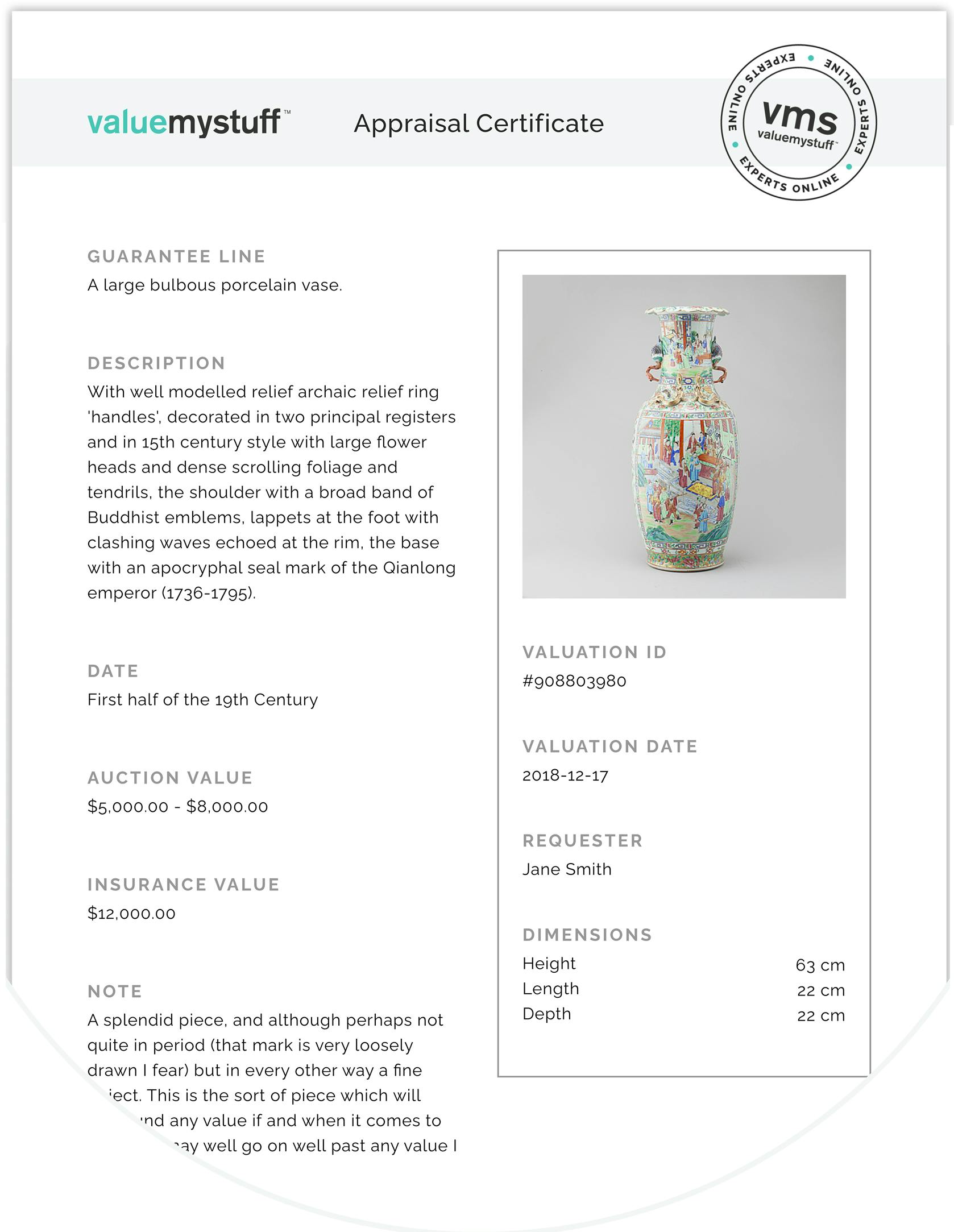
A valuation executed by ValueMyStuff gives you a detailed description of your item, its current fair market value as well as a recommended insurance value. Simply put, you get a personalised valuation certificate with all the information needed to make an informed decision as a seller.
Whether or not selling your object at auction is your primary concern, insuring your valuables against loss or theft is always a smart choice. A valuation executed by experts together with a certificate can be a life-saver. Many global insurance providers require a current appraisal and/or certification a claim to be processed. ValueMyStuff valuation certificates are accepted by a number of insurance providers, and the specialists in the network represent the foremost experts in their respective categories.
The ValueMyStuff network of specialists have worked for leading auction houses, including Sotheby's and Christie's, and are able to value over 50 categories of art and collectables. All you need to do is fill in their submission form and payment details. After that, the information is sent to their network of experts, and you'll receive your certificate according to the response time you selected.
Interested in selling your artworks and collectables at auction? As a valuation client, you can consign your items with Barnebys' global auction-house affiliates. You will have a direct line to selling your collectables and antiques with the top auction houses and dealers worldwide. The valuation service is a fantastic network to connect the leading auction houses with potential consignors.
How a paid valuation works
ValueMyStuff provides expert valuations from the comfort of your own home. Simply upload images and a description of the object, and their team of specialists will create your personalised valuation certificate, including a detailed description of the piece, its current fair market value, and recommended insurance value. It's as simple as that.
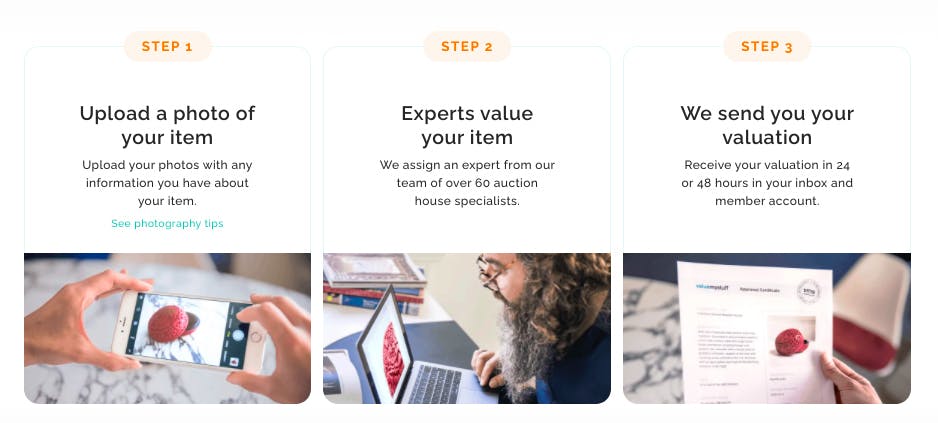
There are many perks to choosing a ValueMyStuff valuation service over the substandard free valuations alternatives. Having a paid valuation service also enables ValueMyStuff to expedite valuation, and provide clients with a 48-hour response time, in addition to offering an express 24-hour service for an additional fee.
They are not only able to guarantee quick and accurate valuation reports based on their specialists’ decades of experience, but are also well positioned to connect users with the auction houses and dealers best suited to sell their particular item. As a ValueMyStuff valuations client, you can consign your items with Barnebys' global auction-house affiliates.
Common ValueMyStuff questions
Do I have to pay for my valuation?
Yes, clients will purchase their valuations for either a 48-hours or 24-hours response time. You also have the option to purchase bulk credit packages for a lower price per credit, which can be used at any time.
What payment methods does ValueMyStuff accept?
They gladly accept all major credit and debit cards, PayPal, and many local payment methods including Bancontact, IDEAL, Giropay and EPS. They're always updating their payment methods to make the checkout process as easy as possible for customers.
What type of objects does ValueMyStuff value?
Their specialists value all major categories of fine and decorative art objects and collectables, including paintings, antique furniture, ceramics and porcelain, watches and jewellery, stamps and memorabilia. For further information on the categories our experts cover, please consult their category page.
How many objects can I submit for each appraisal request?
Each appraisal request is for a single item, unless the item is part of a set (e.g. a set of porcelain, flatware or jewellery). For clients with larger collections, ValueMyStuff recommend purchasing one of their credit packages to submit multiple valuations at a lower price per credit. You can learn about our pricing plans and options here.
What should I include in my object description?
Please include as much information as you can – the more information they have, the more accurate your appraisal will be. Of particular importance are: measurements, marks, signatures, condition of the piece, and provenance (an item’s ownership/sale history). Any additional insights into the artist, date, country or region of origin and the like are also greatly appreciated.
What images should I include in my request?
Please attach high-quality images of the item taken in good natural light from all angles (front and back). Images of any signatures, stamps, inscriptions and maker’s marks are also crucial. Also, images or PDF copies of receipts, documentation or certificates of authenticity will greatly assist in providing you with a precise value. They have photography tips on their 'How it Works' page, which you can check out at anytime to learn more.
Will my insurance company accept a ValueMyStuff appraisal?
Yes, most insurance companies will accept your ValueMyStuff appraisal for their policies. If your particular insurance provider requires a certified appraisal, many of the ValueMyStuff specialists are certified appraisers and would be able to assist you with a separate fee.