Go on a discovery of ancient Asia through the brilliant art its people created: on 2 May, the UK auction house Pax Romana is hosting a sale that showcases some of the very best treasures of this era. From TL-tested Chinese terracotta to exquisitely carved Gandharan statues and Greco-Bactrian silver and Sassanian bronze, the auction displays the immense scope of ancient Asian art.
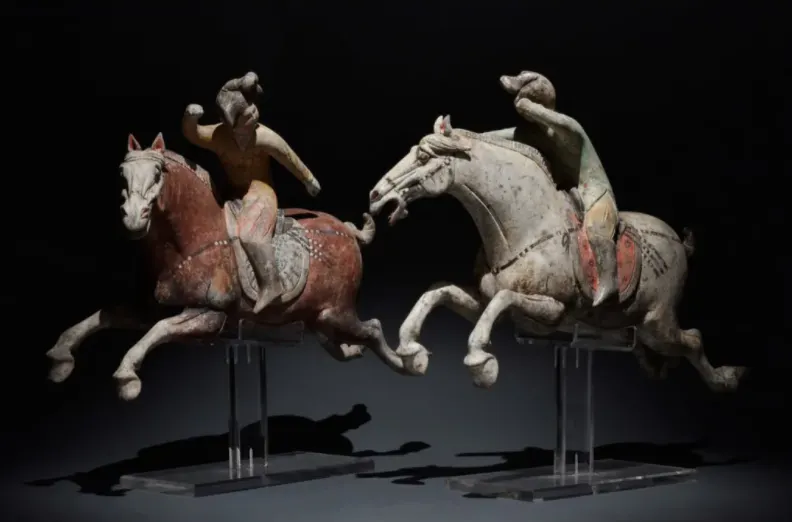
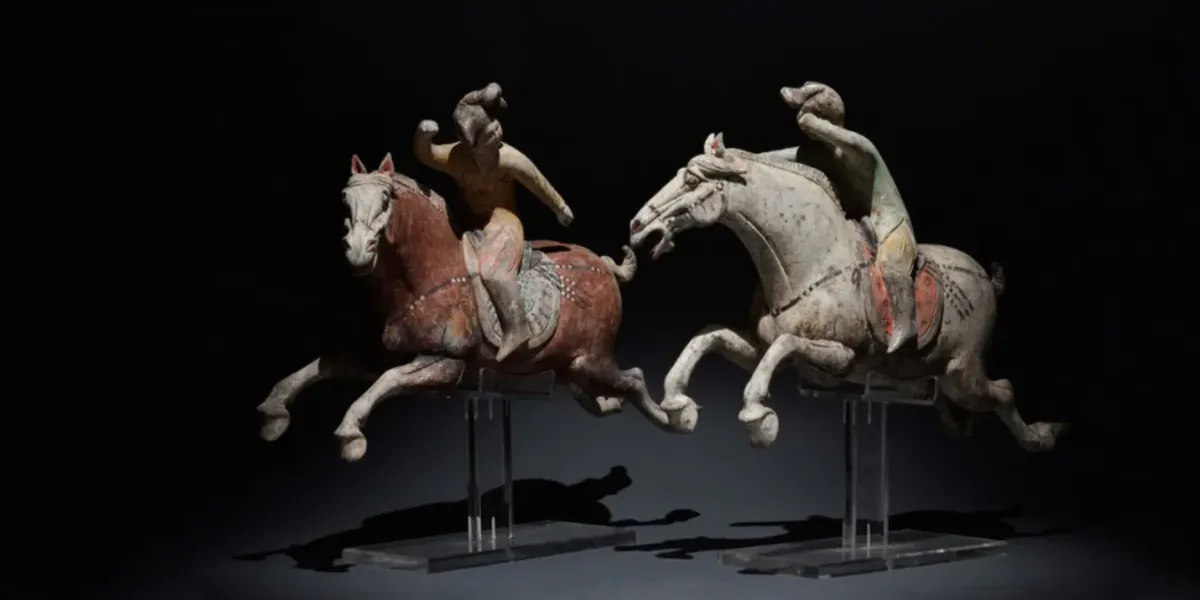
From the Chinese Tang Dynasty, c. 618-907 AD, is this exquisite set of two ceramic female polo players. Both figures have an arm bent over their horse's neck, as though holding the reins. The woman dressed in green has her mallet arm extended, as if to strike the ball, while the woman dressed in orange has her mallet arm at a 90 degree angle, a pose often adopted during play to allow the rider to rest the mallet against the shoulder, keeping their animal's legs clear.
Polo was extremely popular during the Tang Dynasty, and many of the emperors of the period were avid fans who not only played themselves, but also encouraged officials, soldiers, civilians, and even ladies of status, such as the court ladies, to play. This piece has been precisely dated, having undergone Thermo Luminescence analysis by Ralf Kotalla, an independent German Laboratory.
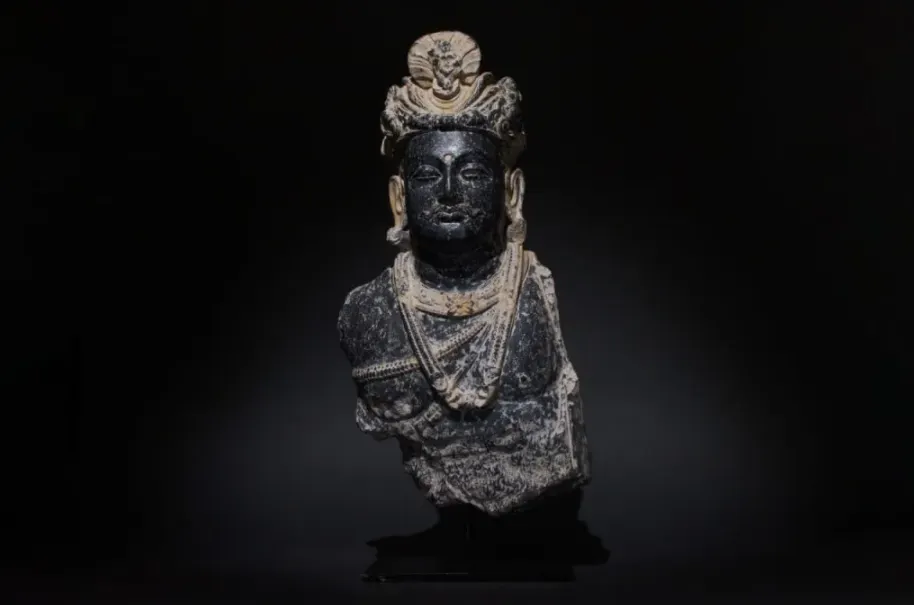
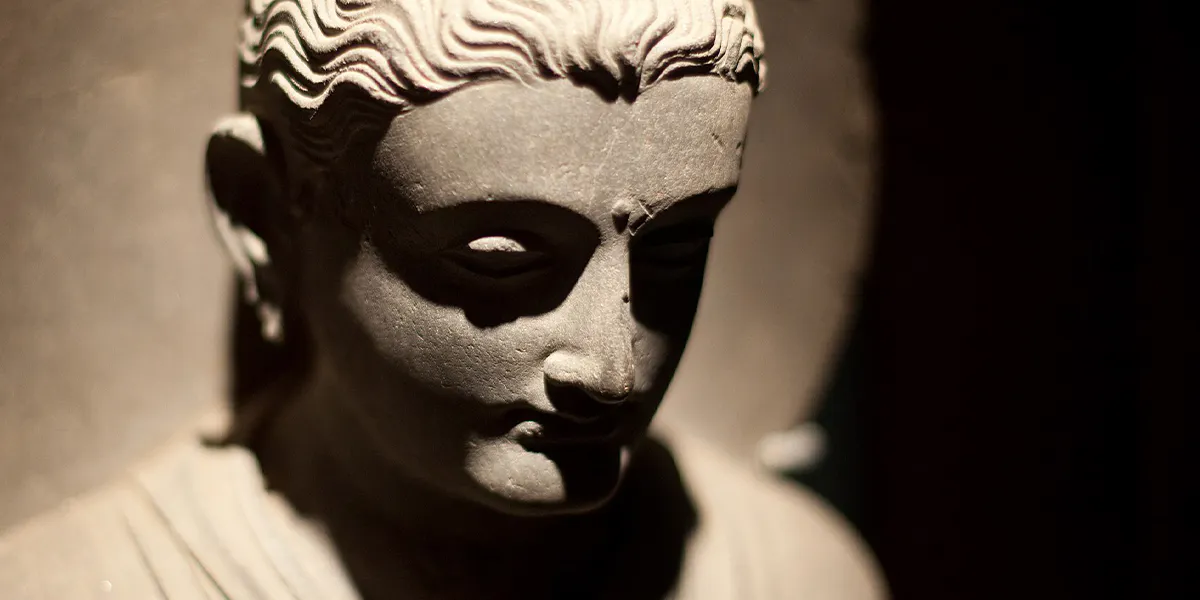
This superb Gandharan black stone torso of a bodhisattva is from 100-300 AD. Buddha is depicted with elaborate coiffure featuring a topknot (Ushnisha), elaborate headpiece, heavy, lowered eyelids, elegant nose, long, undulating moustache, closed mouth, strong chin and elongated, pendular ears. His identity as a bodhisattva is established by the presence of a well-defined urna on his forehead.
All together, these details create a majestic impression of a bodhisattva or individual who is able to reach nirvana (enlightenment) but delays doing so through compassion for suffering beings. The back is rough and unfinished, suggesting this piece was originally placed in an architectural setting. Gandhara was an ancient region in the Peshawar basin in the north-west of the ancient Indian subcontinent. The Kushan period (c. 75-451 AD) of Gandharan art, to which this head belongs, was the golden age of artistic production in the area.
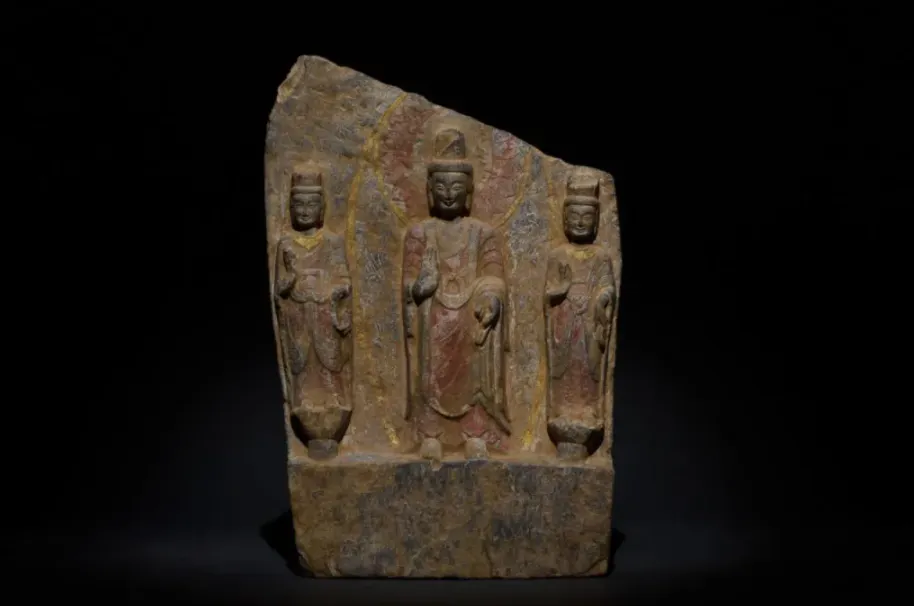
Another depiction of Buddha, albeit in a completely different style and medium, is this painted stone panel/stela from c. 386-534 AD, Northern Wei Dynasty. Here, Buddha, who is flanked by two figures, stands facing towards, smiling, with his right hand raised. This gesture, known as the Abhaya Mudra, symbolises fearlessness. It shows the stage of the Buddha’s life immediately after he achieved enlightenment.
The Northern Wei dynasty ruled northern China from c. 386 to 534 AD, and its most famous achievement was unifying a large empire following a long period of social and political turbulence. However, craftsmen working under this dynasty were also responsible for beautiful works of art, many of a religious nature, as this brick exemplifies.

This bronze hook with silver and gold inlay is from the Warring States period, 475-221 BC. The Warring States period was an era of Chinese history characterised by extensive and ongoing conflict between a multitude of statelets and kingdoms, which ultimately culminated in the Qin state’s victory and the first unification of China into a single empire. In order to confirm its authenticity, this piece has undergone X-Ray Fluorescence analysis.
The piece comprises an arched shaft with pairs of intertwined dragons, a slender neck and a hook formed by a small dragon’s head with carefully picked out details. The reverse features two buttons decorated with geometric designs. Dragons are a symbol of power, strength and good fortune in Chinese art.
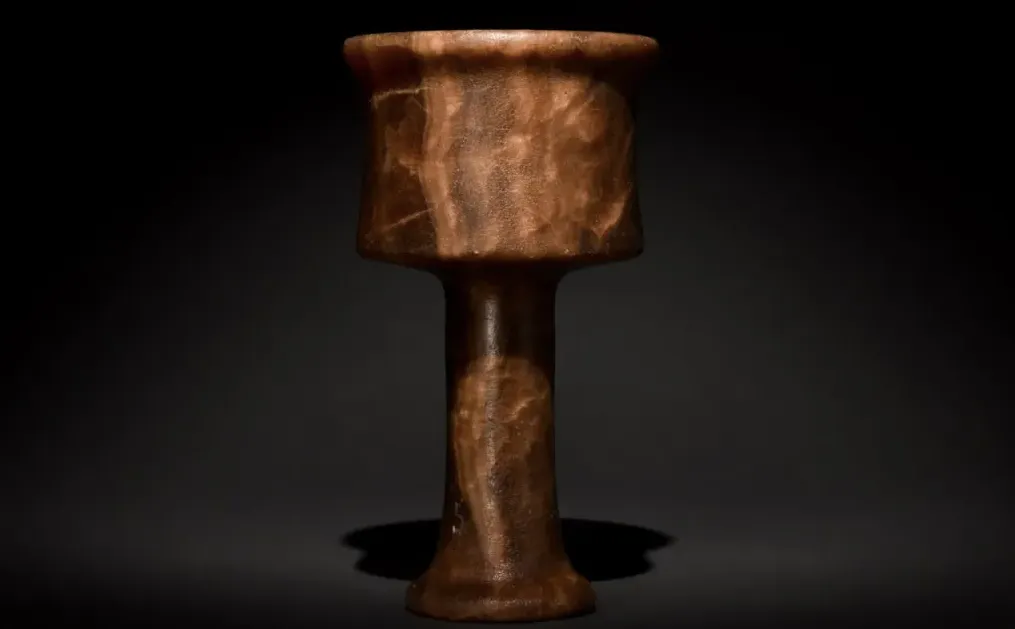
This stunning, dark alabaster Bactrian chalice is from c. 3000-2000 BC. It features a tall stem and a conical base, topped with a bowl with slightly flaring walls. Alabaster was a precious material, widely traded in the region from the 4th millennium BCE onward. The purpose of such a vessel is not known, and pieces like this one often came from burials and votive offerings.
This piece relates to an ancient culture referred to both as the Bactria-Margiana Archaeological Complex (BCAM) or as the Oxus Civilisation. The Bactria-Margiana culture spread across an area encompassing the modern nations of Turkmenistan, Tajikistan, Uzbekistan and Northern Afghanistan. Flourishing between about 2100 and 1700 BC, this culture was contemporary with the European Bronze Age, and was characterised by monumental architecture, social complexity and extremely distinctive cultural artefacts that vanish from the record a few centuries after they first appear.
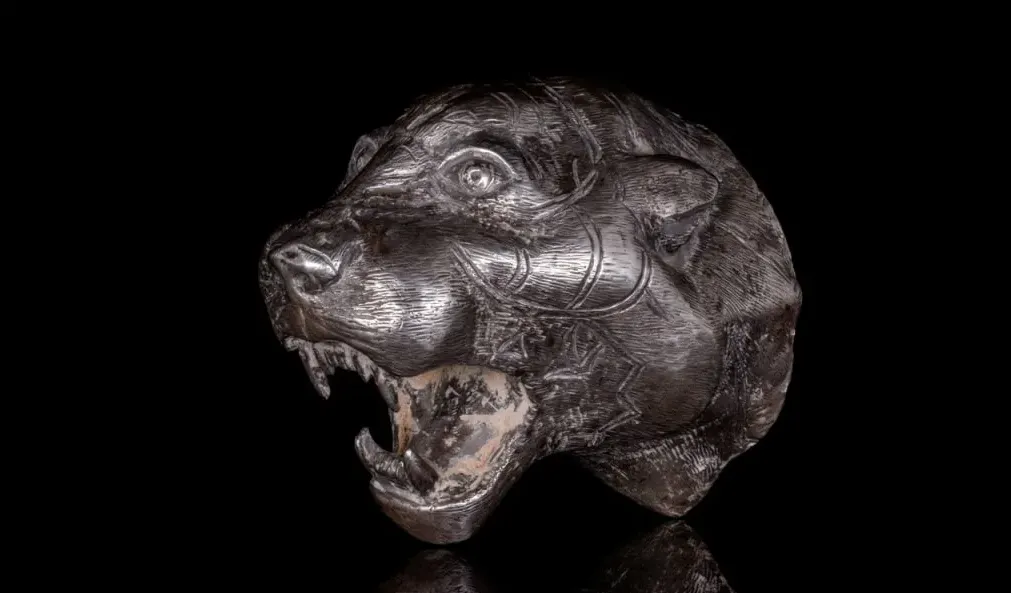
We end this tour in 300-200 BC, with a Hellenistic, Eastern Greek silver tiger’s head protome, probably once originally attached to a rhyton. The tiger is depicted with an open mouth, large, bared fangs, and wide eyes as if fixed upon its prey. Its tongue, pressed against the bottom of its mouth, creates the impression of roaring. The beast’s fur is faithfully textured, and the details of its stripes are picked out in engraved detail.
A rhyton is a roughly conical container from which fluids were intended to be drunk or to be poured, whether as part of a religious ritual or during feasting. These vessels are commonly decorated with animal protomes. The Hellenistic period, which runs from the death of Alexander the Great in 323 BC to the battle of Actium in 31 BC, was an era in which Greek-speaking peoples controlled much of the Eastern Mediterranean and Western Asia as far as present-day Afghanistan. During this time, Greeks encountered many fearsome beasts, including elephants, which they used in war, and tigers, which they depicted in their art as a means of respect for these creatures’ deadly prowess as hunters. In order to confirm its authenticity, this piece has undergone X-Ray Fluorescence analysis by an independent Belgian Laboratory.
You have until 2 May to bid on these ancient artefacts, as well as the more than 150 other antiquities going under the hammer in Pax Romana’s ‘The Art of Ancient Asia’ auction.